Craftsmanship meets precision
How WM Ironwork’s use of Tekla Structures led them to introduce the Trimble X9 3D laser scanner into their workflow, increasing their abilities tenfold by significantly reducing rework and improving on-site measurement.




How WM Ironwork’s use of Tekla Structures led them to introduce the Trimble X9 3D laser scanner into their workflow, increasing their abilities tenfold by significantly reducing rework and improving on-site measurement.
Download a formatted PDF of the story here
WM Ironwork, a family run company that has grown steadily from a small local fabrication workshop into one of the South West’s leading steelwork companies, has built its reputation on precision steelwork and traditional craftsmanship. However, like many fabricators, the company faced recurring challenges with its manual site measurement methods, especially on complex, time-critical projects.
WM Ironwork offers its skilled design and fabrication services across a range of operations from large refurbishment projects to bespoke railings and staircases. Regardless of the type of job, Drawing Office Manager and Senior Draughtsman Steven Cane, could see the limitations of their current site measurement process that was based on manual methods.
Using tape measures and pen and paper, the process was time consuming and required at least two people, leaving the company’s skilled workforce constantly battling handwritten notes, smudged dimensions and soggy paper on rainy days. This was further hampered by the busy nature of the sites which often featured restricted access, numerous vehicles and constant distractions while trying to take slow, accurate dimensions. Inevitably, a small error on site, such as corners of structures not being at exactly 90 degrees, or insufficient points recorded in site notes would lead to return visits and, in the worst-case scenarios, costly rework.
Throughout its history, WM Ironwork has consistently invested in technology. For Steven, this forward-thinking ethos provided the perfect foundation for adopting 3D laser scanning in his search for more accurate and complete site data:
“One of our main aims was to avoid errors and revisits, because a small measurement mistake can quickly snowball into multiple additional site visits and costly rework. In short, it can be catastrophic. I knew a 3D laser scanner would give us the complete, accurate data we needed to solve these problems. With the company growing and our workload increasing, the time was right to introduce one into our workflow to support the needs of our expanding business.”
For Steven there were two stand out reasons that placed the X9 at the top of his list.
“First and foremost, we’re not surveyors or scanning experts so it was important that we found a system that not only delivered the functionality we required but was also extremely easy to use.
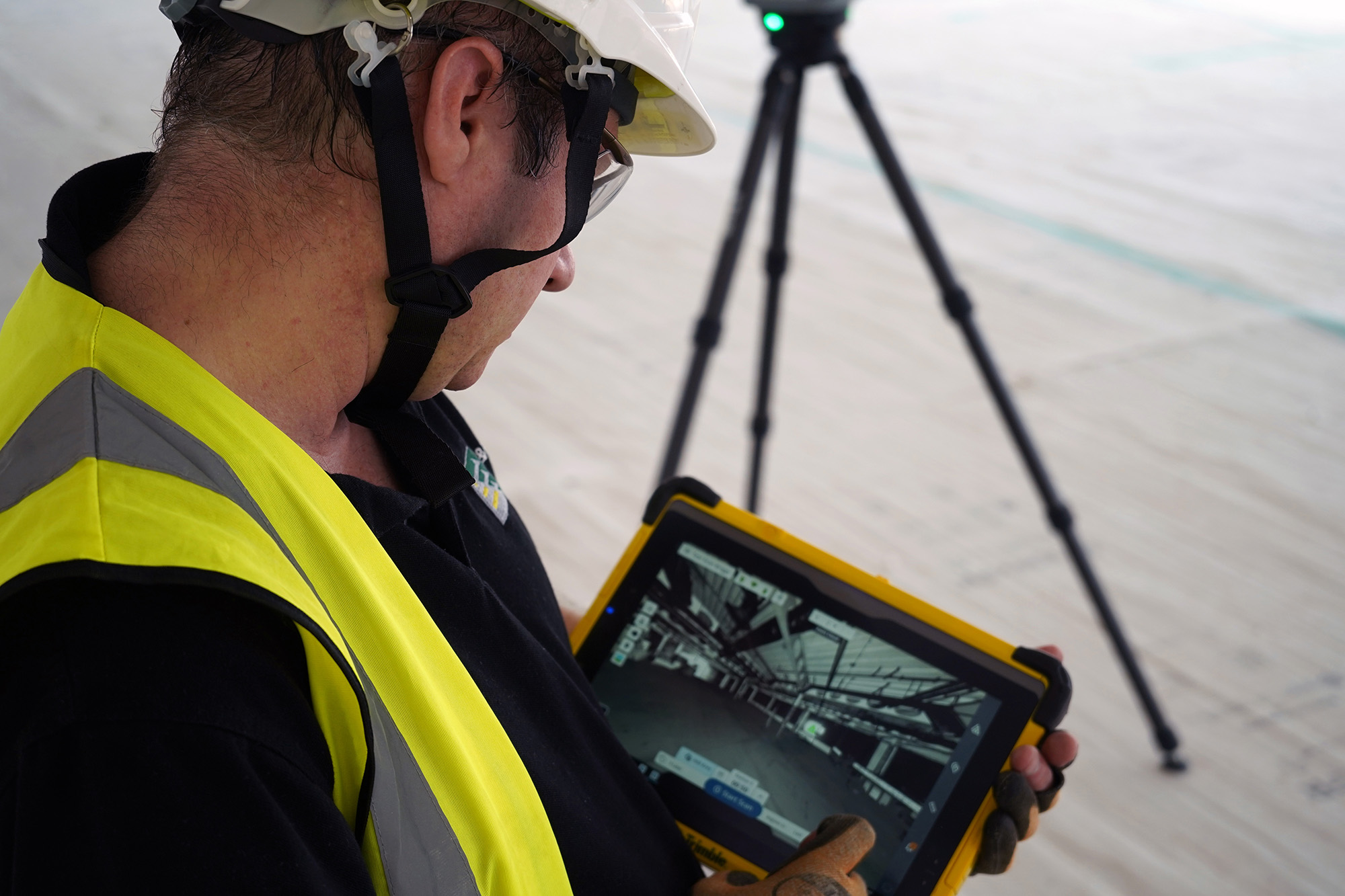
“Secondly, being part of the Trimble eco system through our use of Tekla Structures, we knew that we could import point clouds cleanly into Tekla for modelling, clash detection, and as-built verification. This led us to KOREC who recommended the Trimble X9 Core with Perspective software running on a T10x Tablet and Trimble RealWorks office software for processing.”
X9 functionality that was particularly relevant for WM Ironwork’s site measurement included:
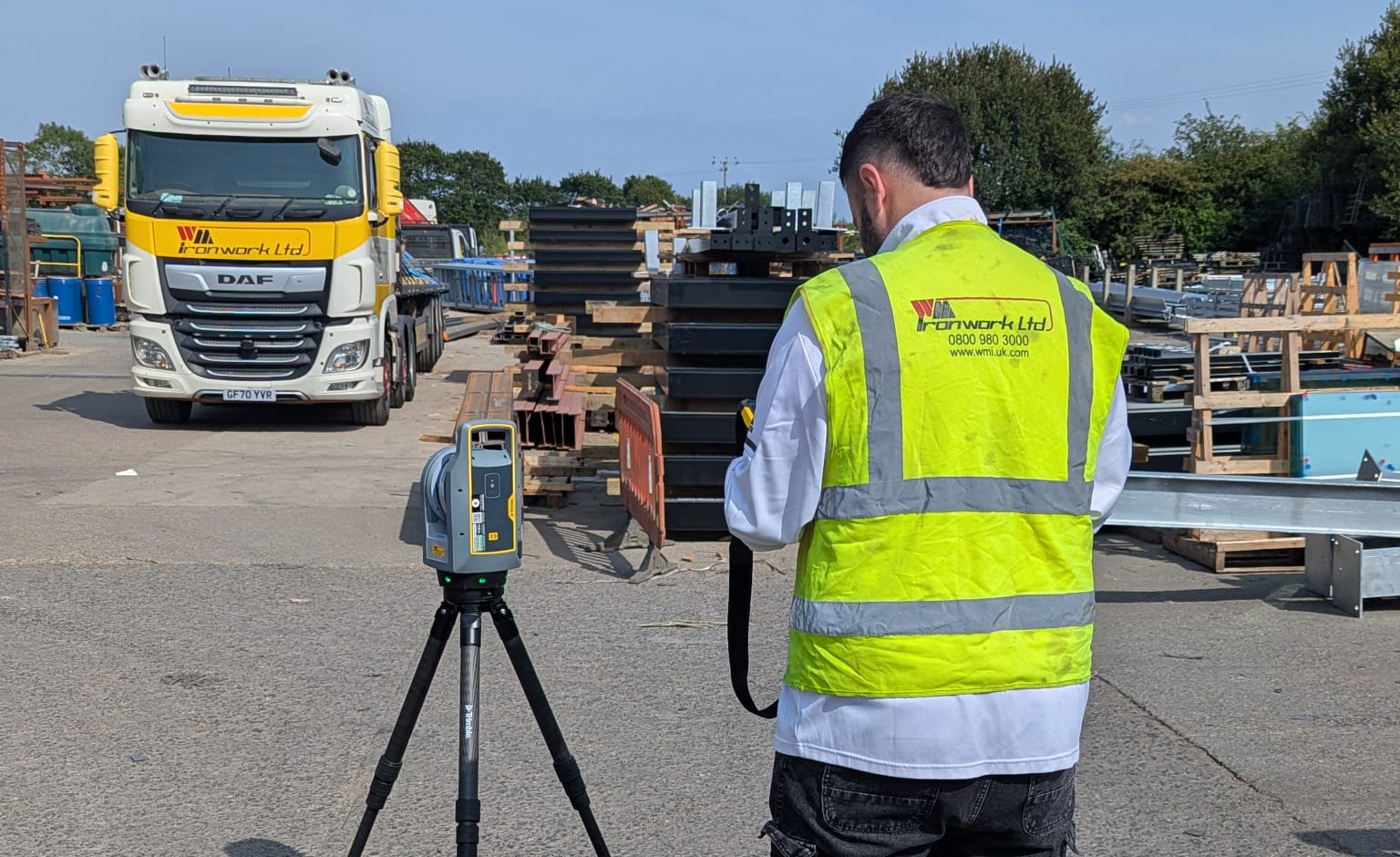
Following delivery and just a day of basic training from KOREC, Steven reports that even team members initially unconvinced by scan adoption were quickly won over by the X9’s ease of use.
After a year of using the new X9 workflow he concludes:
“The Trimble X9 system has been a good decision for us and has really catapulted our abilities by a factor of 10 beyond what they were before. We’ve calculated that we’ve seen a 40% drop in reworks over a year and we’re also getting data that you just couldn’t get without it – so yes, we’re big fans!”
Massive reduction in costly site revisits and rework
Faster turnaround for customers from site measurements → drawing → fabrication
Ability to take on more complex or bespoke jobs profitably
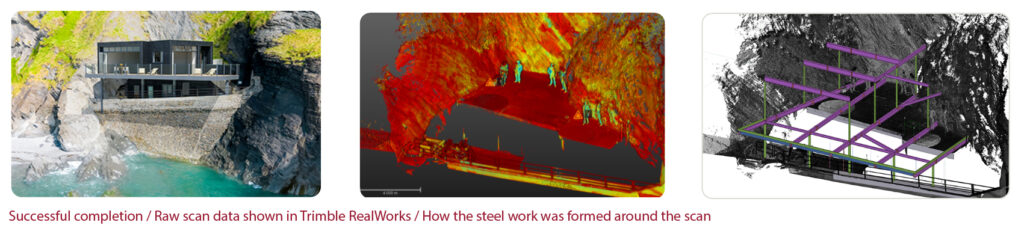
Tunnels Beaches, a beautiful hotel and wedding venue in Ilfracombe, is set into rugged cliffs and features certain areas only accessible via 19th-century hand-carved tunnels. The hotel’s refurbishment plans include the opening of a new suite in 2027, constructed on top of an existing building and reaching back into the cliffs behind it.
For this project, WM Ironwork needed to map a very uneven cliff edge to within a few millimetres to ensure that new steels would sit correctly within the finished building. They also needed to relate the cliff face to an existing building and new retaining wall, to ensure that the updated structure could be built on top of the existing building.
Using the Trimble X9 turned this into a straightforward ‘one-man’ job. The laser scanner was placed on the existing roof and four different station setups were completed. Each scan took four minutes with photos (?), more than sufficient for the required detail. On-site registration in the Perspective software on the tablet ensured nothing was missed, eliminating the need for return visits.
Back at the office, the scan was processed in Trimble RealWorks and the point cloud was quickly trimmed down to only what was needed – just five minutes of work in RealWorks saved the team hours in Tekla.
Additionally, the ability to import the scan data directly into Tekla Structures and use the clash checking feature meant that they could model far more quickly and accurately.
Stand-out benefit: An extremely complex job, that may have been impossible to complete successfully with manual measurements, was executed perfectly, with zero issues.
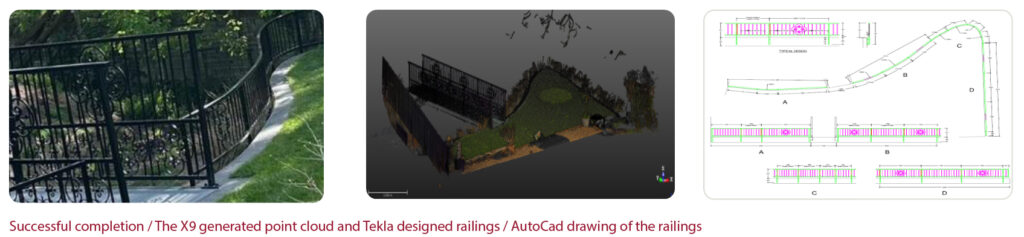
This project featured several sweeping curves that would have taken hours to survey. With six set ups, the X9 was able scan all the curves in around half an hour enabling WM Ironwork to roll the steel at their workshop to the precise shape needed to fit perfectly. The draftsperson was also able to use the panoramic photos created by the X9 to assess exactly how the railings would fit and avoid any obstructions.
Stand out benefit: All works were completed accurately at their workshop avoiding the need to conduct on site reworks, or refabrication.
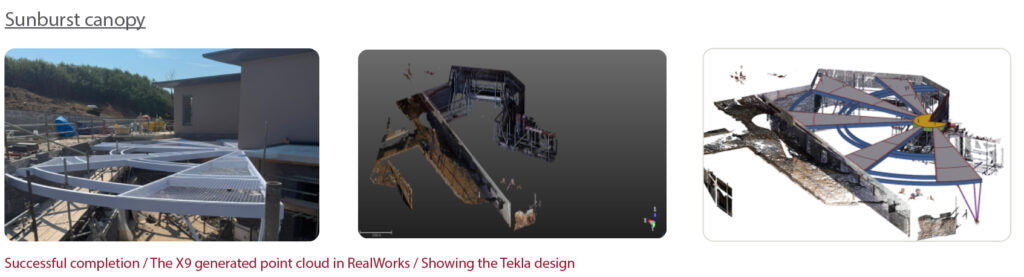
The main challenge on this project was that the steelwork needed to hit multiple points on several different elevations. Measuring them by hand would have been almost impossible due to the location being several metres above the ground and uncertainty of the designs final position.
The X9’s ability to create an ‘all-round’ picture of the environment meant WM Ironwork could overlay the proposed shape of the canopy and adjust it to fit the site as required. Only four scan set ups were required to create a model detailed enough to show all the essential data.
Stand out benefit: straightforward scanning workflow ensured accurate measurement of a remote site and easy adjustment of the canopy model for an exact fit
To date WM Ironwork are using their X9 in four specific ways:
Massive reduction in costly site revisits and rework
Faster turnaround for customers from site measurements → drawing → fabrication
Ability to take on more complex or bespoke jobs profitably
For further information on the Trimble X9 3D Laser Scanner, please contact us here.