Restoring the Thames
How centimetre accuracy, delivered by a low-cost Trimble Catalyst GNSS system, proved the perfect fit for monitoring seagrass recovery on the multi-million-pound Transforming the Thames Project.




How centimetre accuracy, delivered by a low-cost Trimble Catalyst GNSS system, proved the perfect fit for monitoring seagrass recovery on the multi-million-pound Transforming the Thames Project.
Download a formatted PDF of the story here
In May 2026, hundreds of seagrass shoots were carefully planted into the mudflats of the Thames as part of the multi-million-pound Transforming the Thames Project. Bringing together 20 partner organisations spanning academia, industry, government bodies and conservation NGOs, this ambitious initiative, coordinated by the Zoological Society of London (ZSL), aims to restore 320 hectares of interconnected coastal habitats, including saltmarshes, native oyster reefs and vital seagrass meadows.
As part of one of the UK’s largest seagrass restoration efforts using this method, conservationists from ZSL collected nearly 1,000 cylindrical ‘seagrass cores’ which are tubes of mud containing multiple dwarf eelgrass shoots and roots. Taken from a healthy donor meadow in Essex, they were then transported and planted into the carefully selected site in Kent.
However, the project’s success depends on more than just planting. The team must monitor both the impact of harvesting on the donor meadow and the establishment of the new plants and needed to do so with far greater precision than their traditional measurement methods were delivering.
As the restoration work progressed, the ZSL team, including Sasha Shute, Project Officer within the Seascapes Programme, identified several challenges with the previous approach. The team had been marking harvest locations with bamboo canes and navigating back to them using a standard basic GPS. However, some of the canes attracted algae which smothered the surrounding seagrass and blocked light. Sasha explains:
“The cores we harvest are 10 centimetres in diameter and we need to take a point right in the middle. Centimetre accuracy means we can navigate back to the exact same core position and count the shoots that have regrown within that 10cm circle. That gives us a very specific record of the impact our harvesting is having. Very quickly we were able to establish that it was the bamboo canes affecting regrowth rather than our harvesting.”
The team’s priority was clear: avoid any risk of damaging the healthy donor meadow. Harvests took place over three days in May and were followed up by a visit in August, at the end of the growing season, to check recovery. With the sites covering huge muddy areas, it was evident that the old methodology using canes and approximate positioning was no longer accurate enough.
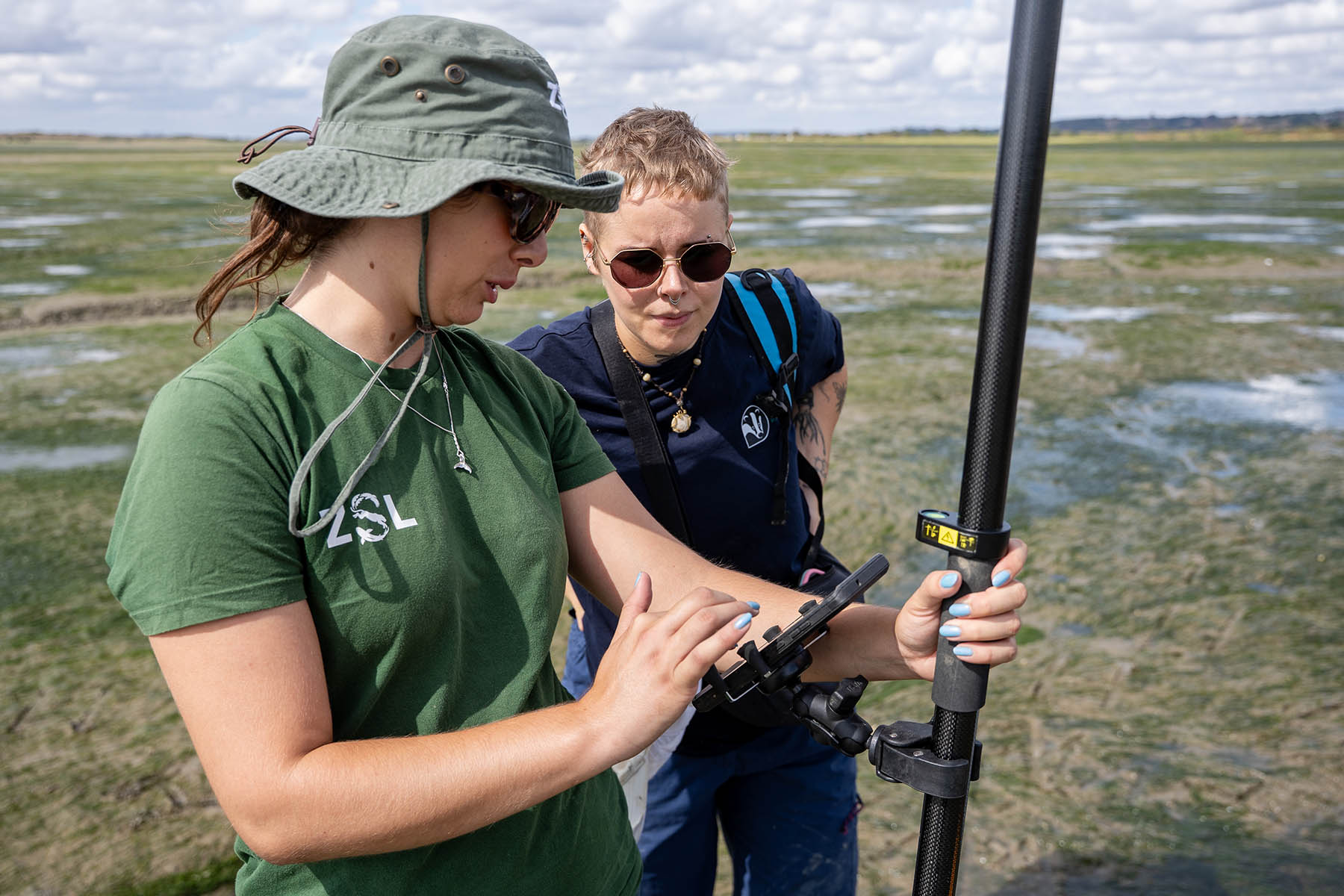
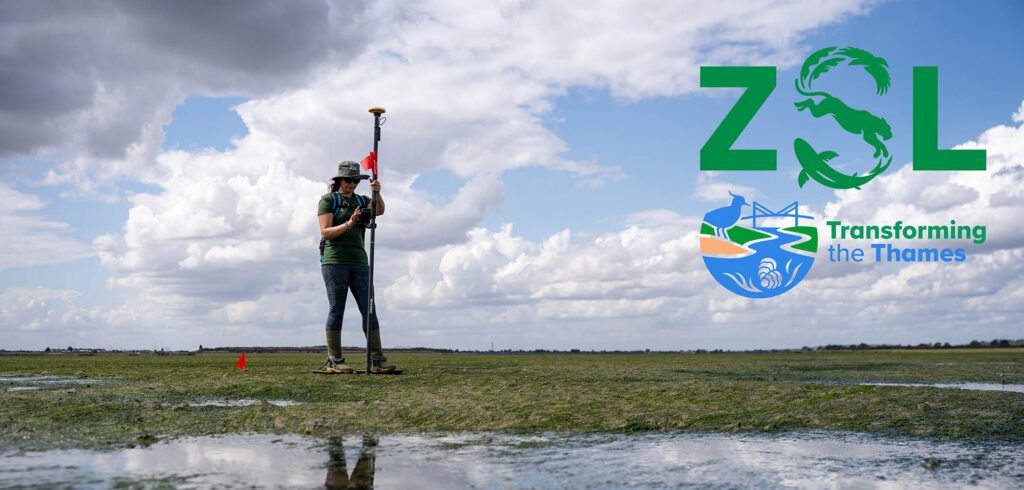
Recommended by project partner Project Seagrass, ZSL introduced a KOREC-supplied Trimble Catalyst system. The lightweight, centimetre-accurate GNSS solution is used with a standard mobile phone running TerraFlex, Trimble’s easy to use intuitive field data capture software. Data was transferred between site and office via Trimble Connect, a cloud-based common data environment (CDE). ZSL opted for a Catalyst subscription, bought from the KOREC online Cataylst shop. This subscription was for centimetre accuracy in a 10-hour package because their work is not continuous but in a carefully planned slots over two or three day periods during the year.
In the office, the team uses QGIS to manage maps and select monitoring points. After harvesting 882 cores, they chose a representative 10% subset made up of 88 points evenly spread across the site and these were uploaded from QGIS to the field device.
Out on the mudflats the system proved straightforward. The hardware is light enough to carry on the long walks across the intertidal zone, setup is quick and the pole mounted system easy to handle even with muddy hands. Sasha notes:
“We never had any issues in the field. Trimble Catalyst is easy to learn, reliable, and particularly good for intertidal work because there are no buildings or other obstructions. One call with the KOREC team to run through the setup was all we needed and the subscription approach works very well – just a quick visit to the online Catalyst shop – we’ve even done it out on the mud!”
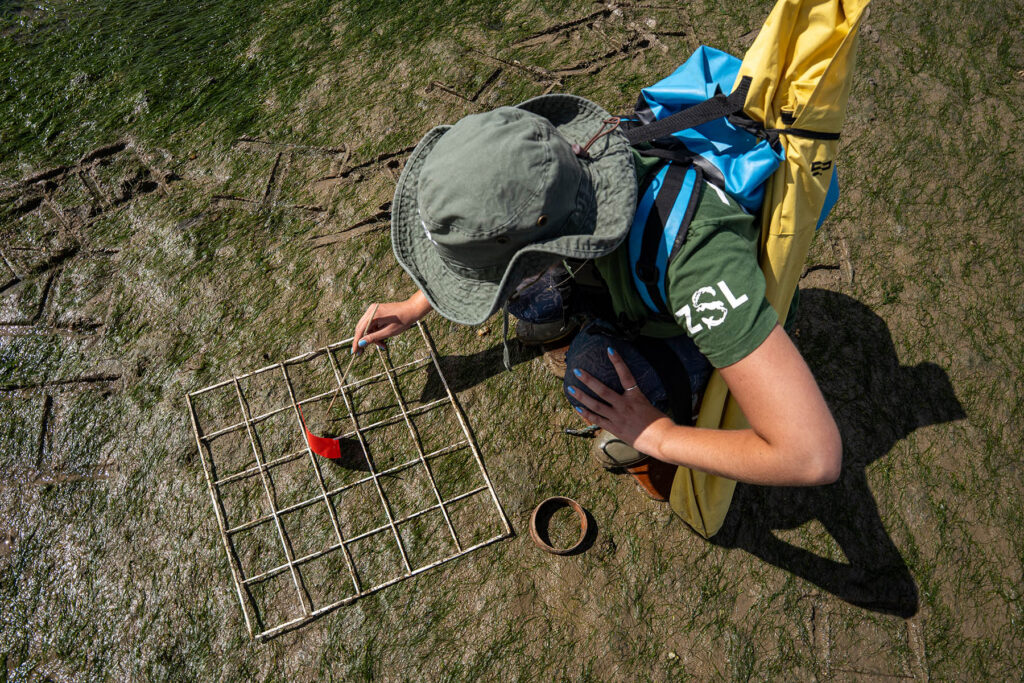
When the team returned at the end of the growing season to re-survey the 88 monitored cores over two days, the findings were encouraging. There was no sign of the blackening previously associated with the bamboo canes and the data provided all the supporting information Sasha needed:
“The number one thing we’re trying to make sure is that we’re not having any adverse impacts on the existing seagrass meadows. That’s our biggest priority. With the centimetre accuracy we can locate the exact point we took from and understand how that specific area is recovering. We’ve a far better understanding of our actual impact rather than the monitoring itself being a hindrance. An added bonus is that I no longer need to pull up the bamboo canes, a job that definitely won’t be missed”
The team has also been able to double monitoring capacity (from 40 points the previous year to 88 in 2026) which has strengthened the scientific findings of the project.
The Trimble Catalyst system is already being adopted more widely across ZSL’s seascape work with the team finding new uses for the system:
Sasha concludes:
“The low-cost, flexible subscription model suits project funding cycles perfectly. We don’t have to commit long-term if budgets change. Most importantly, it removes the need to leave anything in the ground that could harm the seagrass. That alone makes a huge difference to what we’re trying to achieve.”
Follow the progress of Transforming the Thames here
A multi-million-pound, 4-year initiative launched in 2025 targeting 250,000 hectares across the Greater Thames Estuary to restore 320 hectares of interconnected coastal habitats like saltmarshes, seagrass meadows, and native oyster reefs.
Transforming the Thames is funded by the Endangered Landscapes & Seascapes Programme, managed by the Cambridge Conservation Initiative in partnership with Arcadia.
For further information on Trimble Catalyst, please contact us here.