

It’s not quite the O.K. Corral, but KOREC’s Cesar Almeida – armed with 20 years of surveying know-how across two countries – takes on one of the industry’s favourite debates: Total Station vs GNSS. Which reigns supreme for topo surveys?
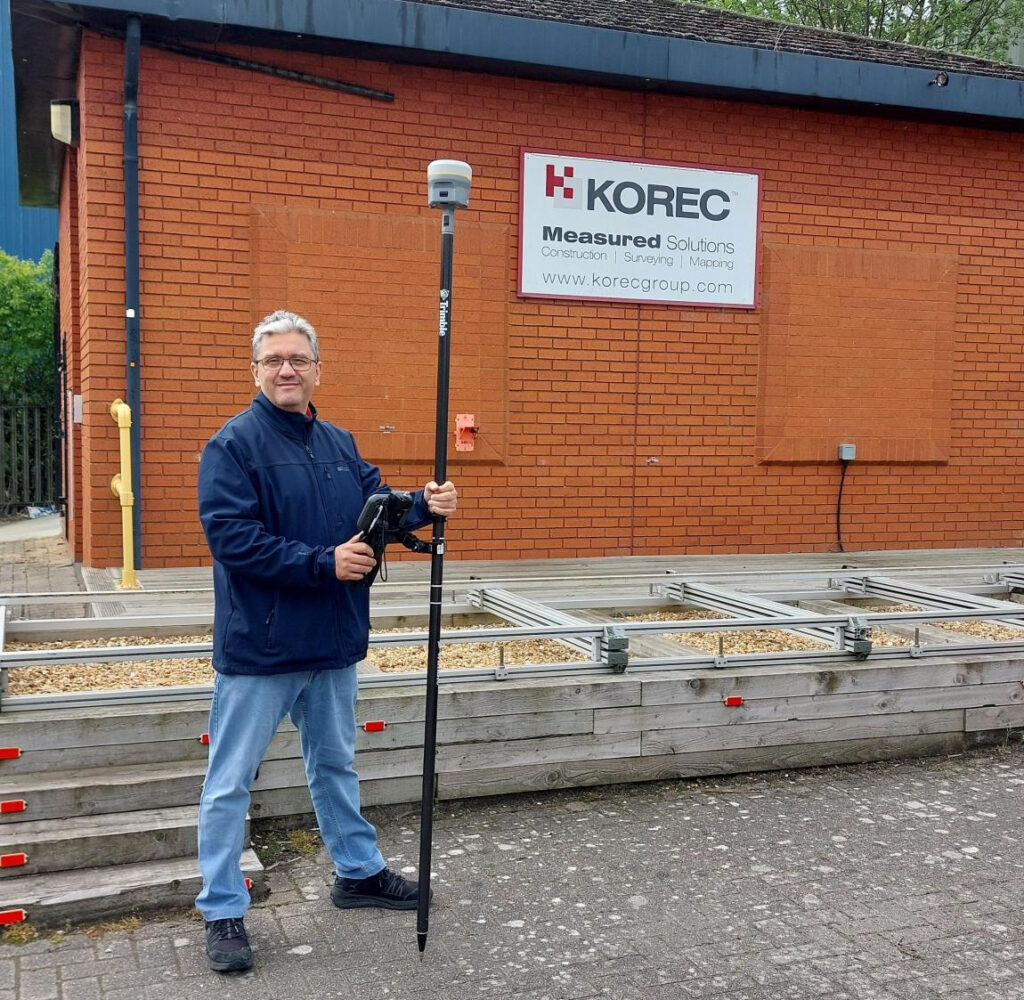
The author, Cesar Almeida
And to add a bit more clarity to the shootout, we’ve brought in KOREC’s Technical Training and Support Director, Richard Selby, to share a few thoughts from out in the field. Take it away Cesar…
A bit of background
“A story to share first. Back in 2005, when the first VRS was established in Portugal, the standard for any surveyor and/or site engineer was very much to use a two-man mechanical total station, and base/rover GNSS.”
Efficient use of the team: manpower matters
“Once they were shown the first GNSS rovers (significantly less costly than a rover and base), the adoption across the mediterranean areas was almost instantaneous over a total station. Customer ‘What do you mean I can swap a team of 2 or 3 people, with a single user on the pole, and get survey-level accuracies for topos?’
The immediate gain is obviously one of better use of the team. Traditional methods using a total station require two people for a topo survey, one holding the pole and another operating the total station, or if a robotic, protecting it from accidental damage or theft. For construction setting out, add in a third person to hammer in the nails or stakes.
During straight forward topo work, a single person can perform these tasks using a GNSS rover, freeing up team members for other projects. And of course, one person is with the rover at all times keeping it safe. It’s therefore easy to argue that the higher cost of a GNSS rover can be justified in operational savings.”
Accuracy expectations: Southern Europe vs UK
“All good, because in that part of the world accuracies under 5cm horizontal and vertical, were fit for purpose for those applications. It’s still the case today.
However, I have been in the UK now for 10 years, and it’s clear and accepted that the standards for accuracies here are higher. There’s probably a number of reasons for it, least of which are TSA guidelines written by the industry and for the industry, which are generally adhered to by customers and companies alike.
This shared standard ensures consistency, credibility, and ultimately, value across the entire supply chain.”
Trimble ProPoint changes it up
“In the last 4 years at KOREC, things have changed. Starting with the introduction of the Trimble R12, followed by the R12i and of course its latest iteration, the R980, we now have Trimble’s ProPoint technology. This gives hugely superior performance under challenging GNSS environments such as under tree canopy and in urban canyons, and the market has responded with several common observations about this technology that more than back up the Trimble marketing spiel:
- Yes, it can measure in more difficult locations than ever before and is much better under canopy and urban canyons than any previous GNSS. (Case study example here)
- Rule of thumb – it has increased productivity allowing users to capture 3 times more data in a day than with a total station or a previous GNSS generation, with enough accuracy for a topo survey. (Case study example here)
- And…the repeatability of the measurements has come down to a point where it’s almost indistinguishable from a total station for topo work. To produce a topo from a ProPoint enabled GNSS compared to a total station has led to results that are now comparable.”
Why wouldn’t you switch?
“So why wouldn’t you use a ProPoint enabled GNSS receiver to do topo work instead of a total station when there are some clearly obvious gains: just one man on the pole, no line of sight required to a fixed instrument, reduction in instrument theft and accidental damage, and overall, faster data capture.”Well, there are of course cons as well
“Recently, I was just discussing with a colleague in sales that the opportunities to use a total station are still quite large and sometimes conditions absolutely dictate that it’s the method of choice because there are still plenty of situations where GNSS just isn’t enough. On construction sites where precision control is critical, or in places like downtown London where skyscrapers turn the GPS signal into spaghetti, total stations are still the go-to. No question. But for a lot of day-to-day work, GNSS is earning its spot in the toolkit — and it’s making a real difference in efficiency and flexibility out in the field.
There’s no doubt that over the last few years GNSS technology has come a long way — and Trimble, with over 40 years of development behind them, has really led the charge. Thanks to these improvements, we’re seeing more and more customers using GNSS for jobs that would’ve traditionally been total station territory. Things like scan-to-topo workflows are becoming more common too, because let’s be honest — scanning is often quicker and easier than setting up a full traverse (at least most of the time!).”
So, what’s my conclusion?
“Unlike the gunfight at the O.K. Corral, it’s taken a bit longer to draw — but here it is:
Now’s the time to consider using GNSS more regularly simply because the technology you find in the Trimble R12i and R980 mean it’s finally accurate and repeatable enough for most applications.
And if anyone can bring a simple balance to an debate like this, it’s my KOREC colleague ‘out in the field’, Richard Selby:
The smart approach? Always remember context is king — the ideal would be to have both a total station and a ProPoint enabled GNSS receiver in the toolkit so that decisions can be made specific to the job in hand.”
What are your thoughts?
Setting out is a laborious, time-consuming yet vital stage of the construction process.
With our February trade-up offer, you can ensure you have the most robust, most productive and most cost-effect setting out workflow available.
To make things better, we’ll give you £4000 / €4500 to upgrade your old survey kit for a brand-new, setting out solution built for the digital construction site.
For more details of this limited time setting out offer, download our handy 1-page PDF.
Prefer to speak to an expert? Get in touch via our Contact page.
Find Out More
- Read how the RTS773 helped Felix O’Hare deliver a complex project 6 weeks ahead of schedule – Customer Story
- Read our handy blog ‘Visual Setting Out – 5 reasons why’
- Browse the full range of robotic total station solutions
How would you like to complete five times the amount of work, with just 1 operative?
More construction contractors are realising the value of visual setting out with robotic total stations. They’re seeing firsthand the gains in speed, efficiency, and accuracy. These benefits translate to reductions in rework, schedule delays, and other costly problems, all of which contribute to a robotic total station’s ability to pay for itself many times over.
What is Visual Setting Out?
But not all robotic total stations are made the same. While prism pole layout is the norm, some robotic total stations also offer a laser pointer. Using a laser is referred to as visual setting out, and it works especially well in structures and buildings that are already erected. When you use a robotic total station that allows you to do both prism pole layout and visual layout, you get the ultimate in flexibility and versatility. Here are five reasons to take a closer look at visual setting out.
Reason 1 – SPEED
When conditions permit the use of a laser, you’re able to speed up the setting out process considerably. You can turn on the laser and stand back as it automatically points and measures, reducing the time needed to position and locate the prism pole. Integrated software in the robotic total station, like Trimble FieldLink, guides you to each point and allows you to switch between surfaces, such as from the floor to the ceiling. You can eliminate extra steps, which cuts the time needed to complete set out significantly, while also gaining greater precision.
Reason 2 – ACCURACY
To get an accurate measurement with a prism pole, the pole needs to be perfectly plumb. Even a slight misplacement could produce a measurement that’s a few cm off. This type of human error is difficult to avoid when you’re relying on manual processes. But when you rely on Trimble’s patented visual set out technology to let the robotic total station do the adjustments and calculations for you, you can achieve much greater accuracy.
The precision of visual set out is especially beneficial for MEP contractors. Pipes and floor drains, for example, have to be accurately placed to drain correctly and pass inspection. Electrical work, HVAC, and sprinkler systems have to be placed accurately at the right elevations to clear other systems and avoid clashes. With the accuracy the laser provides, you can have greater confidence that your work will be set out and installed correctly.

Reason 3 – EFFICIENCY + REDUCTION OF PERSONNEL
Manual setting out is a time-consuming process that can take weeks or longer depending on the size of the project. It also requires that you have enough pros available to complete the work—a challenge given the construction skills shortage. With a robotic total station, though, only a single operative is needed to operate the instrument, whether using the prism pole or the laser. And because of the automated capabilities of the laser, fewer steps are needed to set out points, which significantly reduces the amount of time needed.
In fact, in many cases, you can complete 5 times the amount of work with one person. You’re able to deploy the setting out resources you have more efficiently and across more projects.
Reason 4 – SAFETY
Busy jobsites tend to be full of potential hazards, and performing set out in the midst of these hazards can be risky. With the visual setting component of a robotic total station, you can shoot the laser over 100 meters, which means you don’t have to physically make your way across the jobsite to measure a location. You’re able to avoid trip hazards or other potentially dangerous areas. You can also reduce the use of ladders, which pose one of the greatest safety risks to construction workers.
Reason 5 – COST & ACCOUNTABILITY
Because you can perform setting out more quickly with the laser, you’re more likely to meet the project schedule. And any time you can stay on schedule, you’re improving your likelihood of staying on budget. In addition to performing set out, a robotic total station also allows you to create a record of work performed. Should you receive an RFI or have to resolve a dispute over charges, you can reference this documentation to show what you did and why. This same feature lets you quality check your work as you go so you can identify and resolve problems before they turn into profit-robbing rework.
See our full range of Robotic Total Stations for Construction, and other BIM tools.