Delivering early with a holistic model-driven approach
Leading earthworks and civil engineering contractor MJ Church, has combined its holistic, model-driven approach to complex infrastructure projects with a fully integrated Trimble ecosystem of hardware and software - all hosted within Trimble Connect’s Common Data Environment.
Leading earthworks and civil engineering contractor MJ Church, has combined its holistic, model-driven approach to complex infrastructure projects with a fully integrated Trimble ecosystem of hardware and software – all hosted within Trimble Connect’s Common Data Environment.
The outcome: An exceptional level of operational control that enabled the team to complete the excavation and backfill operations (required for an innovative ‘box slide’ installation) a full day ahead of the scheduled nine-day Christmas possession. This work was carried out on the complex M27 Junction 10 Improvement Scheme in Hampshire.
Scheduled to finish in 2026, this project is being delivered by Hampshire County Council, working closely with National Highways appointed main contractor VolkerFitzpatrick, and earthworks and civil engineering contractor, MJ Church.
The design of the M27 Junction 10 improvement scheme, which includes a new motorway underpass and three new slip roads to support the new Welborne Garden Village, was determined by National Highways’ decision to adopt the innovative ‘box slide’ construction technique for the underpass. This approach required the excavation of approximately 22,000 m³ of clay and chalk to create a safe working void for the installation of the 8,500-tonne reinforced concrete underpass structure via hydraulic jacking.
The nine-day possession of this eight-lane section of the strategic road network meant that contractors had to meet strict-deadlines with no margin for error – a challenge that placed a strong emphasis on planning, collaboration and data accuracy.
Key to the precision and efficiency with which this section of the works was successfully executed was the MJ Church digital-centric approach led by Construction Technology Lead, Sam Lemon.
Responsible for all the model’s updates and the survey, volumes and drone data used to refine it, Sam saw that the constant flow of information between site and office as a vital aspect in establishing the model as ‘a single source of truth’. He delivered this by establishing Trimble Connect as the common data environment (CDE) for the project.
Meeting project challenges with the 3D Model
For Sam, the complexity of the project presented significant pre-construction challenges: How can we prove that the box slide will be successful? How can we demonstrate this approach to the client and stakeholders and win their confidence? Is this actually buildable? And more specifically during the works: How can we ensure that the skilled machine operators have a full understanding of the data they are working with? Is the survey correct? Are we confident in the expected volumes and therefore achievable outputs? Can we fit these machines into this space safely and what plant is suitable for that width?
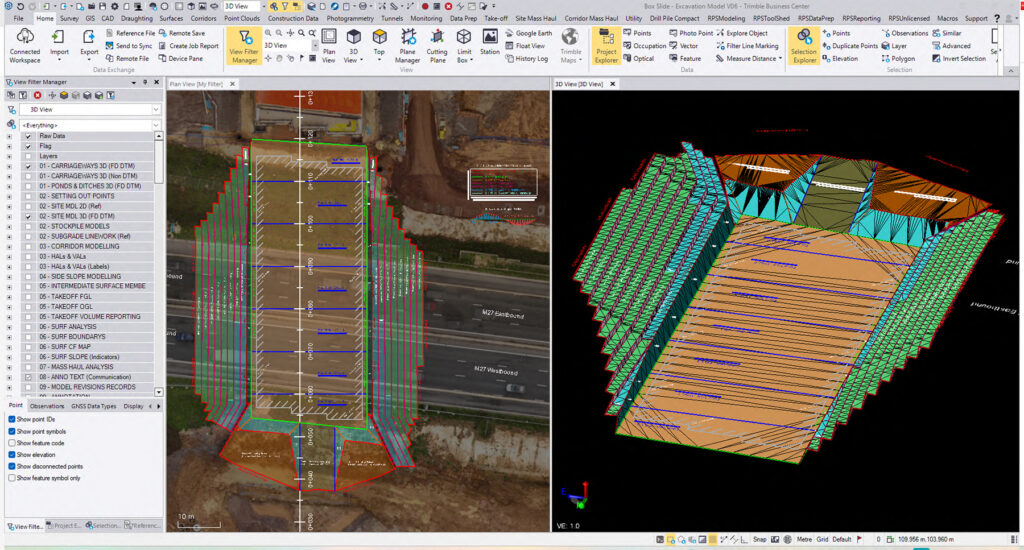
Trimble Business Center was used to create the 3D model
MJ Church’s solution to these questions, and many more, was to fully model the construction phases in Trimble Business Center (TBC) software. All survey data, including the original topo survey, along with inputs from other sources such as their DJI Mavic 3 Enterprise drone, was seamlessly imported into this platform.
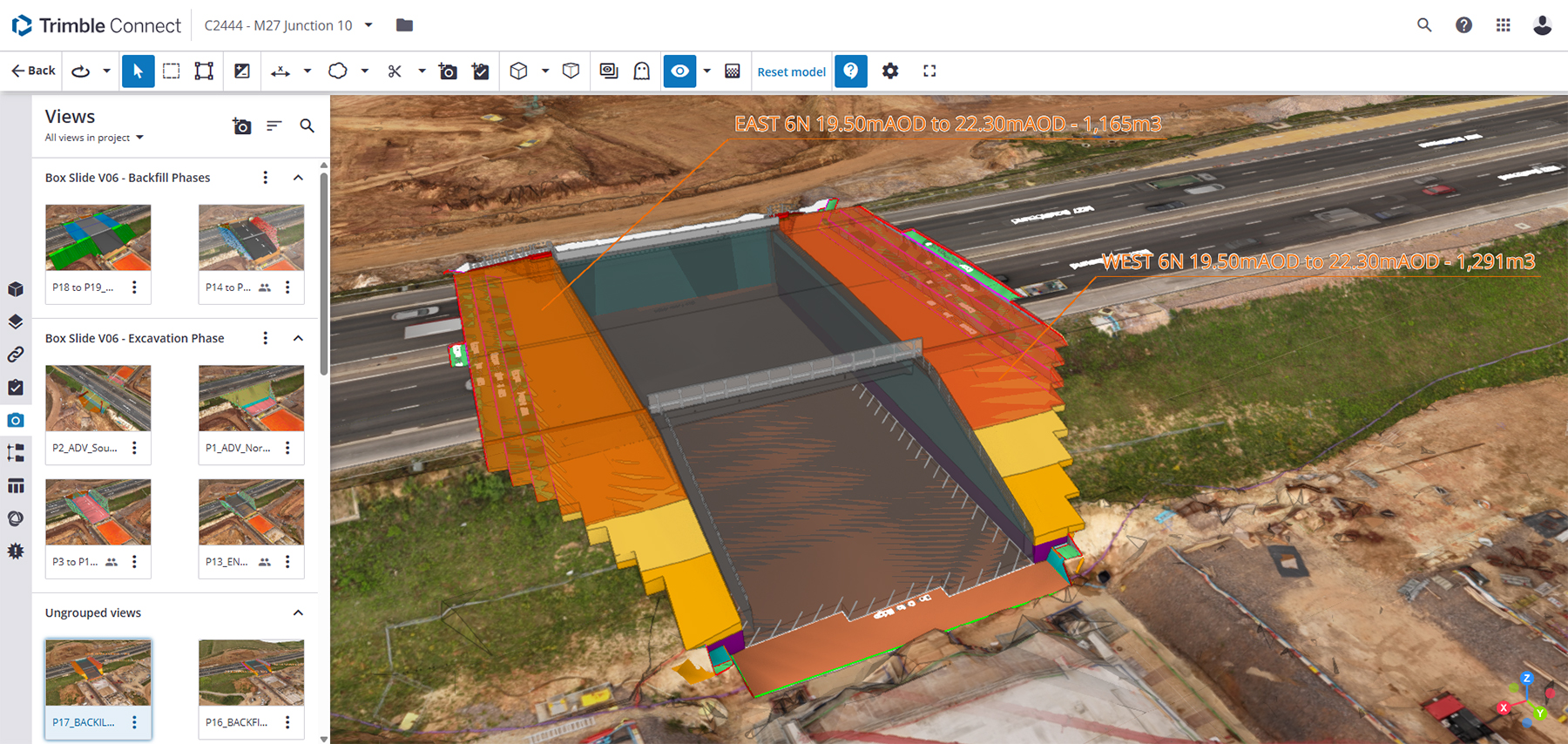
Working collaboratively with VolkerFitzpatrick, Sam took the initial linework Civil 3D model and transformed it into something from which the machine operators could derive real utility, refining it over 6 iterative versions into a highly detailed, risk-mitigating end result. This model served every stakeholder and provided the essential foundation for the digital rehearsals conducted ahead of the 19-phase excavation.
Democratising the model with TBC
True to MJ Church’s ethos of geospatial data democratisation, the model was transformed in TBC from initial outline design, into a holistic tangible model that was accessible, communicable and usable by every stakeholder.
Sam drew on his extensive knowledge of Trimble Business Center software for processing and modelling geospatial data and used this to ensure that each of the models created for the works, including the advanced offline earthworks, controlled possession excavation, and multi-material backfill operations, were developed with the specific needs of the machine operators in mind.
He used extensive detail including colourisation, text, slope lines and easy hosting of the 3D IFC file for the box to interrogate the model relatively. He also spent some time on simple details such as making the bottom of the bench green and the slant of the bench grey for easy identification.
The high quality of the models generated in TBC resulted in excellent feedback from downstream users, with Sam explaining:
“TBC has one of the best and most robust 3D engines on the market, invaluable for interrogating and manipulating all types of geospatial data in full 3D alongside other assets. I cannot think of a better tool on the market for doing that work. It’s a drag and drop environment that can basically handle anything. When the client sends an IFC file of the structure, I can drop that in. If it’s a point cloud collected from the drone, that also goes in without any hassle. Trimble has really thought about TBC from a construction model point of view.”
Soarvo data sharing and handling cloud software added a highly visual aspect of the planning and checking process by bringing the scale to life and assisting with material planning movements.
The completeness of the 3D model enabled the team to pre-empt problems and optimise the design ahead of the works. In one example anticipating undesirable weather, alterations were made to the model to introduce a 1.5% longitudinal fall into the benching excavation, allowing the rainwater to be managed towards pumps if required.
In another example, Sam used TBC’s powerful corridor tools to create the H:1.50m x V:1.0m benching geometry. These tools allowed the work in progress model to remain dynamic and easily editable as the planned design was collaboratively optimised in consideration to other constraints. A separate corridor was created for the East and West benches, and it was quickly identified that the benches could not run parallel with the formation excavation due to the varying elevation on the expected clay and chalk strata and the interface with the 70° sidewall at the base of the excavation. Thus, the azimuth direction was skewed independently on each side to optimise the intersect line. This reduced the excavation volume required under possession as much as possible.
Streamlining project collaboration with Trimble Connect
Throughout the project, Sam has underlined the importance of having a single source of truth where everyone can view, share and access project information from anywhere, at any time. Central to this process has been Trimble Connect:
“By using Trimble Connect as the host for our model and all the geospatial data, we removed the irritating process of constantly asking ‘which model… is it this one?’ whilst looking at it through somebody else’s Teams or a native software that simply couldn’t bring the data to life. Our approach is to be as transparent as possible, all agreeing from the same source in the same environment. I like to think of our approach as practical BIM without the unnecessary bloat”
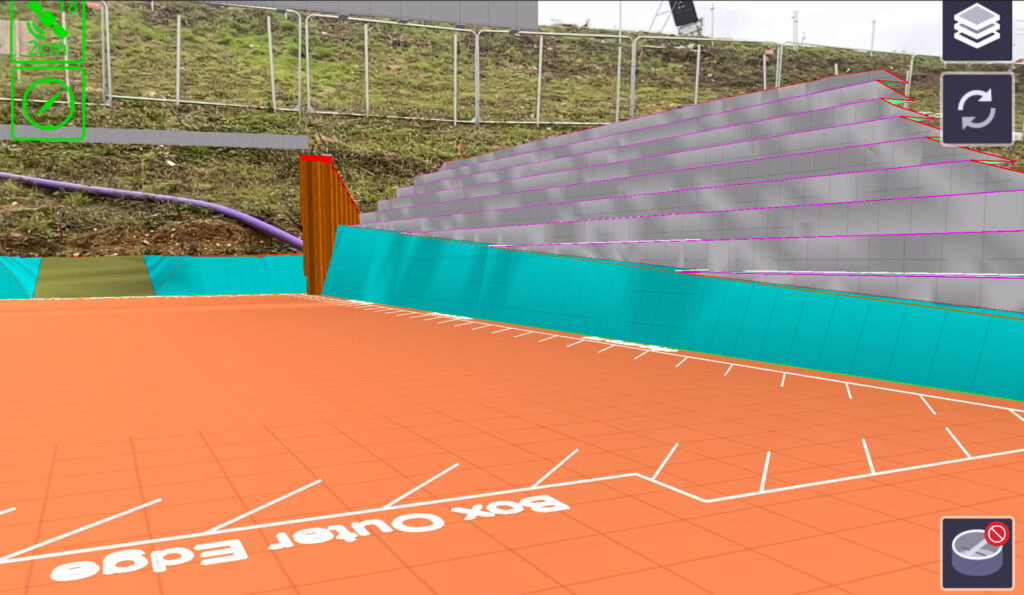
Above and below – Trimble SiteVision was used for for enhanced on-site visualisation, clash detection and decision support,
Handling over 45–60 file formats (including IFC, DWG, PDF, point clouds, geospatial data, and Trimble-specific formats), and with strong 3D viewing capabilities, Trimble Connect served two clear functions on this project: Firstly, as a folder structure for the Trimble Access field/survey software to dial into and pull data across and secondly, as a collaborative CDE for planning and hosting the digital rehearsal process which was a significant element in the project’s success.
Trimble Connect enabled a smooth flow of information across the Trimble eco system which included:
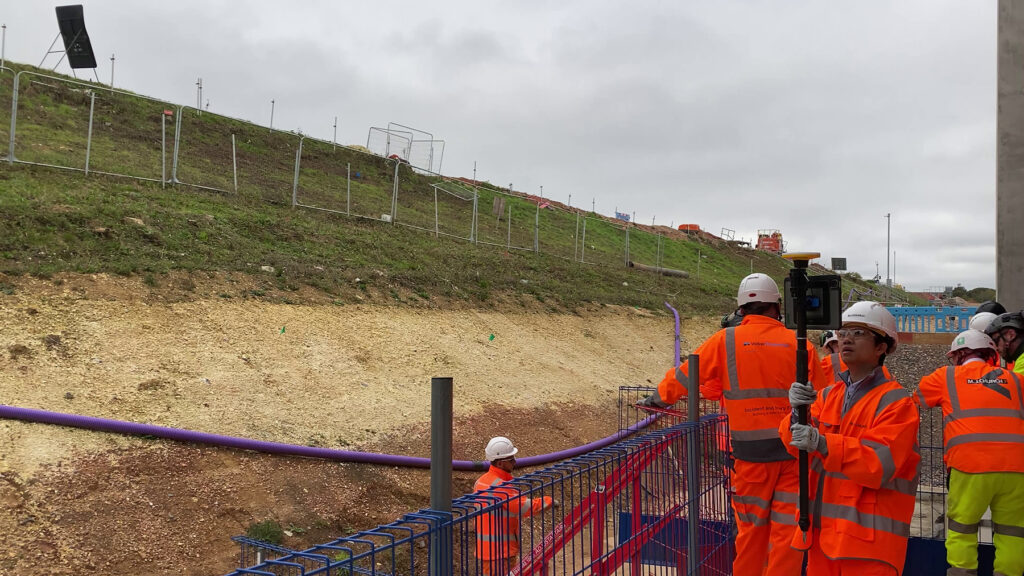
Trimble R980 GNSS Rover used for checking the control network, setting out, grade checking and recording as-builts. These GNSS rovers and on-machine MS976 receivers were selected for dependability and in particular, the ProPoint technology. ProPoint brought robust performance on a site with many potential degradation issues such as moving machines and working in an excavation up to 10m in depth.
Trimble R750 Base Station, which served RTK corrections to both the GNSS Rovers, UAV platforms and Machine Control systems via UHF radio and NTRIP in an RTCM formation to increase compatibility.
Trimble Earthworks Machine Control and WorksManager software for centimetre-level accuracy in excavation, grading and material placement.
Trimble SiteVision mixed reality technology for enhanced on-site visualisation, clash detection and decision support, turning a complex piece of work into something tangible and rapidly increasing understanding of the project for those not present full time.
Trimble Business Center for processing field data, model refinement, surface generation, volumetric quantification and quality assurance.
Trimble Access field survey software and TSC7 Logger for synching with the model via Connect. If a change is made in the office, it efficiently propagates down to the site team eliminating setting out errors emanating from potentially incorrect file revisions – no need for USB sticks.
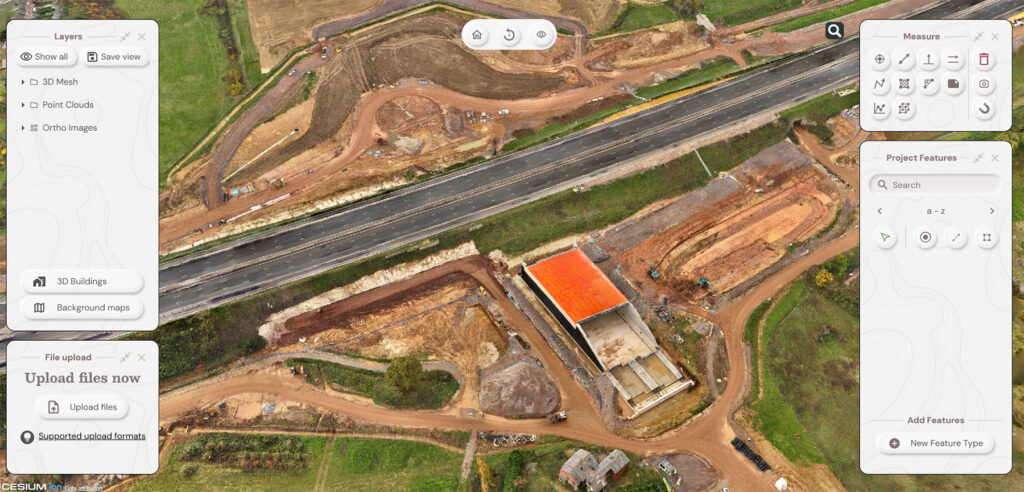
MJ Church also used a KOREC supplied DJI Mavic 3 Enterprise drone and Soarvo data sharing and handling cloud software. Together, they provided an additional highly visual aspect of the planning and checking process by bringing the scale to life and assisting with material planning movements. In Teams meetings, Sam could use Soarvo to spin the whole 3D model to explain plant access, stockpile locations etc.
De-risking with digital rehearsals
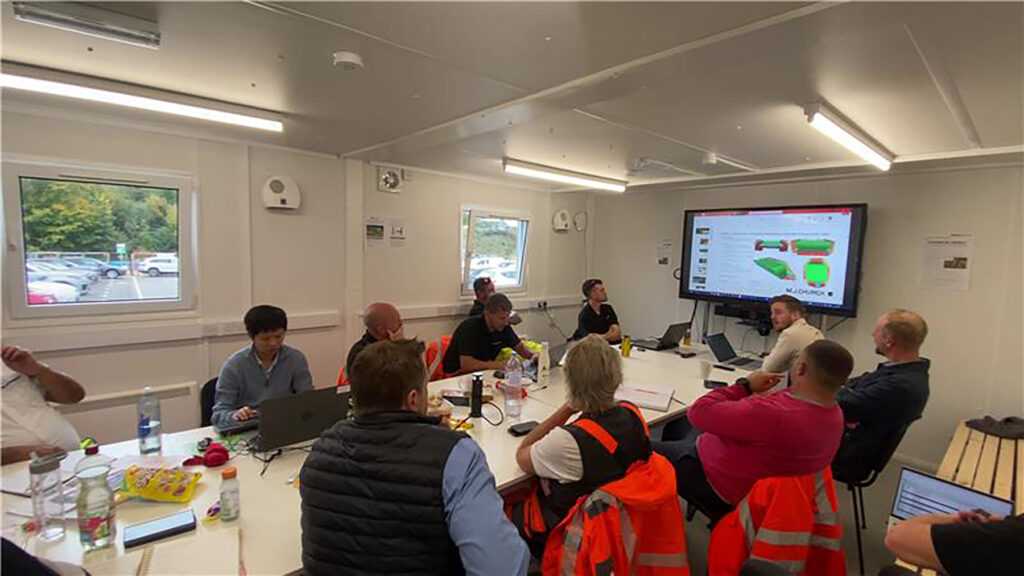
At MJ Church, the digital rehearsal begins before any ground is broken. Using the detailed 3D models developed in Trimble Business Center and shared via Trimble Connect, the company brought together operators, engineers, and supervisors for virtual walkthroughs ahead of the day’s planned activities. Each session was based on an extensive handbook that clearly defined the construction sequence, eliminating any ambiguity around the design and its implementation.
Start-of-shift-briefing
These start-of-shift briefings provide essential clarification of the planned work while reinforcing all health, safety and environmental considerations, ensuring no confusion arises during high-pressure operations. Above all, they served to de-risk the activity from three key perspectives: planning, personnel, and geometry.
Project success and future vision
Following the nine-day Christmas possession, the M27 Junction 10 project was completed successfully a day ahead of an extremely tight schedule. The high level of detail invested by MJ Church in its digital-centric approach was a strong factor in this achievement.
Following his experience on this project as well as earlier ones where the same approach was used, Sam feels that creating an environment where everyone is involved in the model through Trimble Connect really pays dividends. All stakeholders gained clarity and full understanding of these complex works which contributed greatly to the success of the operation. MJ Church is continuing this approach onto one of their next projects on the A47 Thickthorn Junction scheme in Norwich. He concludes:
“KOREC has been an exceptional partner with superb customer service, and knowing we can rely on them to supply the right kit, at the right price, with all the options we need; that it will work, and that it will be fully supported has been an important aspect of this project’s successful delivery.
Trimble’s technology has also had its part to play. Trimble has really thought about it as a platform with a holistic portfolio of products that integrate with each other. This means we’re not battling the platforms to get the output – I know that any work I do in TBC will seamlessly work with Trimble Earthworks, Trimble Connect, Access and SiteVision. We will continue to take this approach in future projects and hope that the results on this project will encourage others to develop a holistic model-driven approach.”
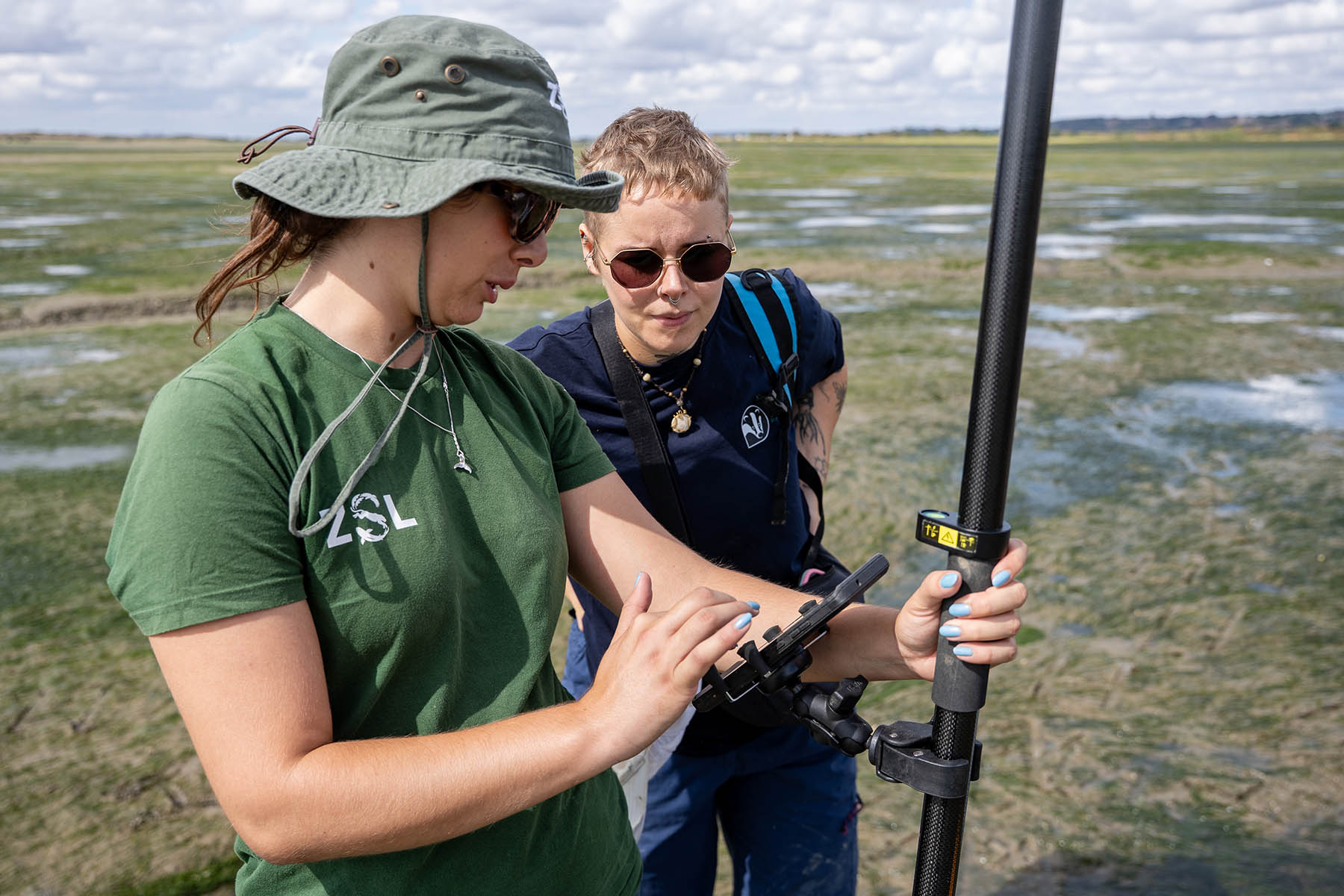
How centimetre accuracy, delivered by a low-cost Trimble Catalyst GNSS system, proved the perfect fit for monitoring seagrass recovery on the multi-million-pound Transforming the Thames Project.
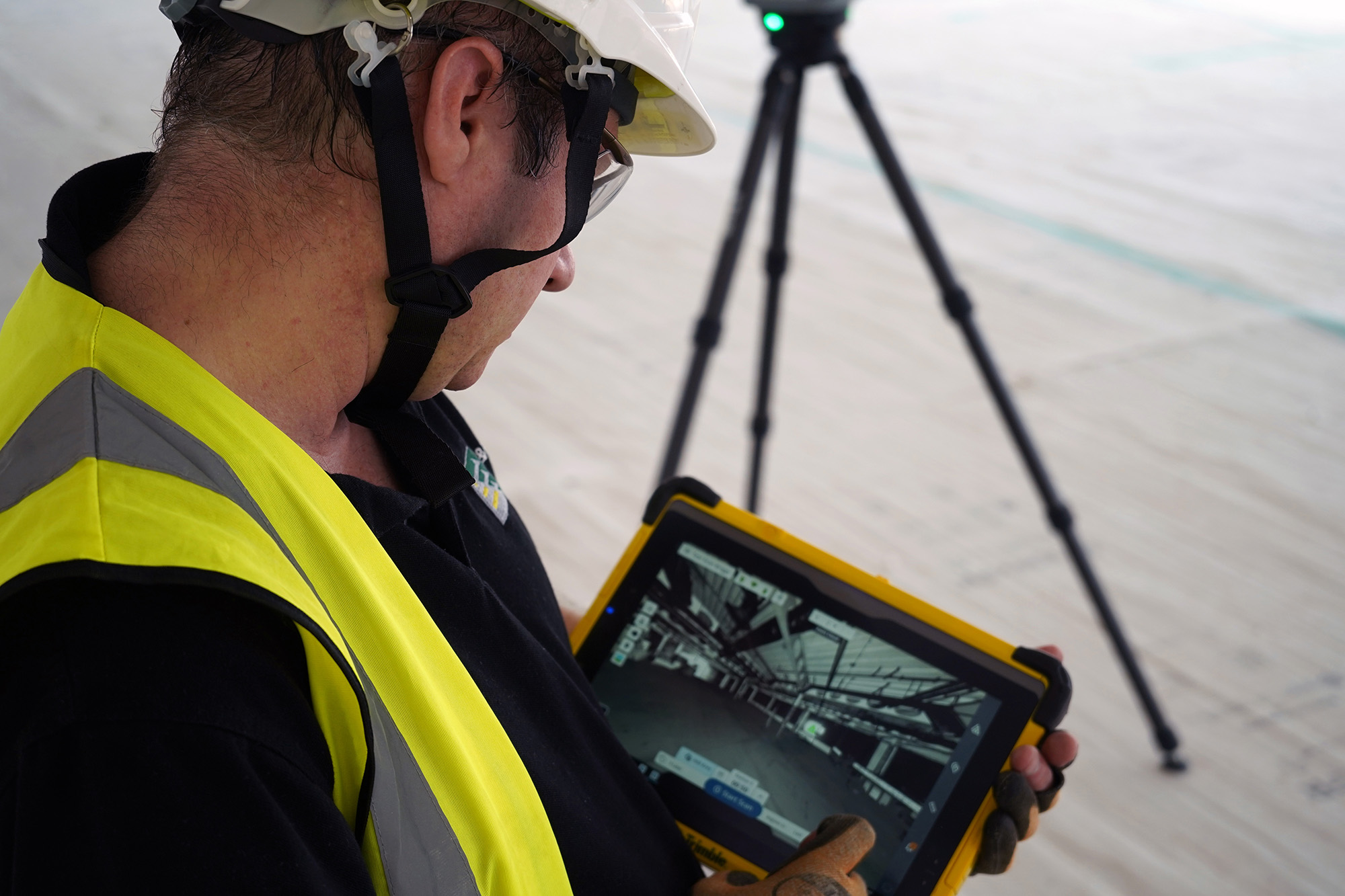
Transforming MEP delivery with the Trimble X9 3D Laser Scanner
Transforming MEP delivery with the Trimble X9 3D Laser Scanner - the recent acquisition of this laser scanner represents the company’s commitment to working smarter, empowering its people and delivering...
IO Geomatics combines over 27 years of topographical expertise with an extensive survey portfolio that allows them to apply the most effective methodologies for each site’s specific challenges. A recent...