
A wise man once said ‘Gold (gold). Always believe in your soul’*. And whilst Spandau Ballet peaked at number 2 on the UK charts with that classic, here at KOREC we are feeling on top of the podium as we’ve hit double gold for Investors in People / Investors in Wellbeing (IIP/IIW).
Our IIP/IIW journey began back in 2023 when we were first assessed – being awarded ‘Standard’ grade for People, and ‘Silver’ for Wellbeing.
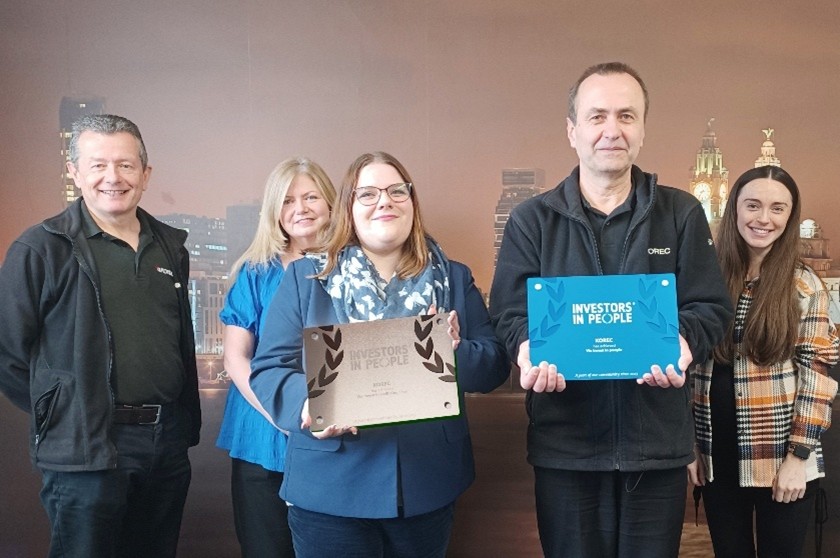
We admit to some slight apprehension during our reaccreditation in January and February. After all, we were being surveyed in what is undoubtedly the bleakest period of the year, and immediately following the news of our acquisition by the Cansel Group – would people be feeling uncertain about their future?
We had no need to worry.
It turns out, even in the bleak midwinter, our people are feeling happy, valued and empowered. There are SO many statistics we could share with you, but there was one that really jumped out at us.
100%, yes that’s every single person, said that they find their work interesting (!).
I am always encouraged to push, use my initiative and go the extra mile’
IIP survey respondent, February 2026
Not only is that a wonderful for them, and for us as a business, but it’s great news for you, too. That’s because the stats show that happy, engaged colleagues are 3 times more productive than unhappy ones.
And it isn’t just about the happiness, wellbeing and productivity of the people we already have. Four-fifths of Investor In People organisations say attracting new talent to their business is more effective – wouldn’t you want to work for a business where 100% enjoyed their work?
Here’s some of the other amazing stats
- 98.8% agree that KOREC is a great place to work. Not a single person disagreed.
- 94% trust both their managers, and their leaders
- 94% also say that the company meets their wellbeing needs
- In fact, our Wellbeing score is a solid 24% above the IIW average
- 95% agree that the organisation embraces change
That change piece is something we’re particularly proud of. We all know that “acquisition” and “takeover” can be intimidating words for many people. We also know that the more informed people are about the changes, what’s happening, and why – the less scary those things become.
We’ve kept our people informed at every major stage of the acquisition – following the announcement in December – and it’s clear from these results that our people are feeling trusted and valued.
‘Engagement and communication about the future are really done well – we have had loads of information about the acquisition, which makes it feel less scary’
IIP survey respondent, February 2026
It may only be March, but with our new Cansel family and our double gold, we’ve plenty of reasons to be cheerful about 2026 and beyond.
What is Investors in People?
A global standard committed to putting people first, improving workplaces and driving success, Investors in People have been making work better since 1991.
They’ve assessed almost 60,000 organisations across 101 countries – surveying and interviewing their staff to get to the truth of what makes them tick.
Investor in People organisations can boast 17% productivity improvements – and 80% of them attract top talent more effectively.
*Yes, it was Gary Kemp. Also fun fact, the song ‘Gold’ is an homage to composer John Barry, and was especially influenced by his scores for the Bond films
KOREC Careers
Join the KOREC team!
We’re always on the lookout for talented people to join the KOREC team. Take a look at our vacancies that span our operations in UK and Ireland.



“With hindsight… we probably should’ve seen that coming!”
Fortunately, as we move towards the end of the year, we have the next best thing to hindsight: a number of recent insights and reports from Trimble that give us a clear view of what’s coming next.
Following November’s KTUC day, we’ve been revisiting a pair of standout presentations from Trimble: a forward-looking keynote from Boris Skopljak, VP of the Geospatial Sector, and a UK-focused future of Trimble data capture session from Lee Braybrooke, Key Accounts & Alliances Director. Throw November’s Trimble Dimensions event and a newly published Trimble report into the mix and we’ve got plenty of insight as to what’s coming our way.
This piece is a quick round-up based on these sources which can all be read via the on page links.
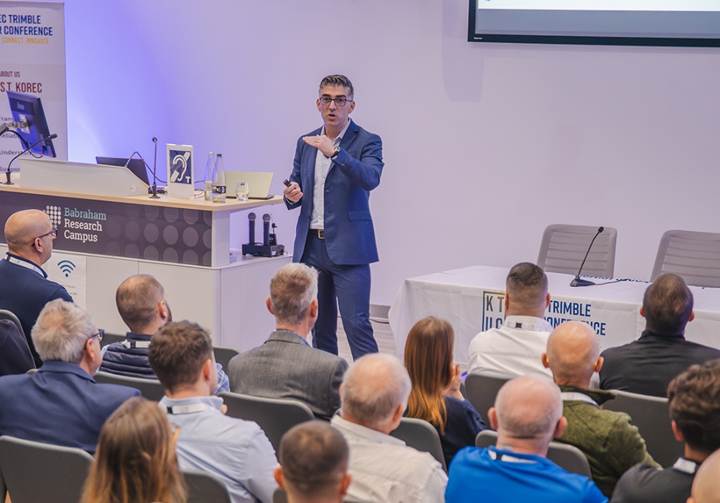
A forward-looking keynote from Boris Skopljak, VP of the Geospatial Sector
Context and action
Our industry’s challenges are well-documented and they’re not going away on their own. The most frequently cited include a shortage of skilled people, slow adoption of digital workflows due to perceived complexity or unfamiliarity and increasingly siloed data – we’re getting better and better at capturing information, yet not nearly as effective at managing, sharing, or making the most of it.
If we are to successfully address these challenges, there are five key steps that Trimble recommends we take:
- Embrace AI and automation
- Leverage cloud solutions
- Focus on user experience
- Prioritise training and skill development
- Foster innovation
Let’s take a closer look.
1.Embrace AI and automation
It’s one of the hot topics within our industry and we already understand that automated workflows remove repetitive manual tasks, deliver faster design & modelling cycles and improve accuracy in jobsite documentation and coordination between teams. But how can we improve?
Step forward Trimble’s agentic AI platform, a collection of core services, security frameworks and tools. Built on top of this platform is Trimble Agent Studio which is currently being piloted with select customers to support its AI strategy by:
- Helping users learn and navigate Trimble software for faster onboarding and engagement.
- Eliminating the manual steps typically required to model from scratch, enabling users to generate 3D objects during design by describing what they want to model.
- Converting voice memos into documents in the field, capturing status updates from crews and helping teams avoid spending hours in front of computer screens back at the office.
- Accelerating access to data and streamlining asset maintenance and permitting workflows.
For more information, visit our recent KOREC blog
2.Leverage cloud solutions
Accurate data underpins everything in geospatial and construction. It shapes decisions, affects project outcomes and keeps day-to-day operations running smoothly. Cloud platforms give you a single, central place to manage that information, making sure everyone is working from the latest, most reliable version. KOREC customers tell us time and time again that siloed data is a regular occurrence and an enormous hinderance to their progress, which is why we offer a range of cloud options – Trimble Connect, Trimble Reality Capture, Trimble Terraflex and SOARVO.
The Trimble report states that the geospatial industry will increasingly adopt cloud-based platforms for managing large datasets and facilitating near real-time field-to-office-to-field workflows for better outcomes.
Important to note is that industry users state the importance of using platforms that prioritise data security and offer robust backup and recovery options.
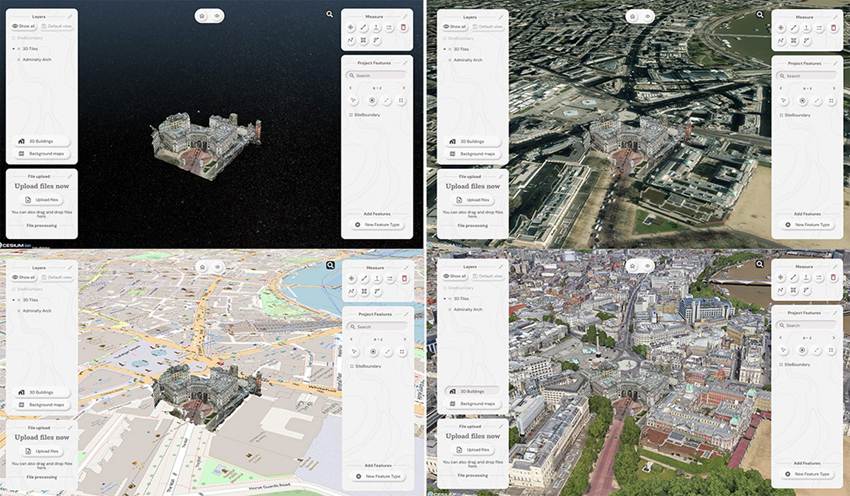
Leverage cloud solutions
Discover Soarvo3.Focus on user experience
A user-friendly software interface can significantly reduce the training burden and speed up the adoption process, making advanced technologies more approachable for both new and experienced users. Balancing user-friendliness with professional requirements is a key challenge and on that score, Trimble has already made great inroads. For example, the ease of purchase and use of Trimble Catalyst by those outside of our industry and of course through the massive take up of 3D Laser Scanning through the intuitive workflows of the Trimble X9 series.
Trimble predicts that developers will focus on creating solutions that offer a seamless user experience, incorporating features such as guided workflows, contextual help, and simplified data visualisation – all good news.
4.Prioritise training and skill development
Within our industry, there is an increasing emphasis on spatial awareness and digital data analysis and management, but surveyors must also have a solid understanding of geodetic principles and coordinate systems to ensure the accuracy and integrity of their work. As the industry adopts advanced technologies, surveyors must become proficient in digital tools and software.
How is that being achieved? Trimble survey respondents use on-the-job training (69%), in-person training sessions (57%) and video tutorials (56%), but approaches vary widely, with some designating an expert, some getting group support and some relying on the vendor.
The Trimble report predicts that professional development programs will likely place greater emphasis on digital skills and that the role of the surveyor will evolve to encompass both traditional surveying techniques and advanced digital methodologies.
5.Foster innovation
And finally…the Trimble report urges us to encourage a culture of innovation by leveraging the skills and perspectives of digital natives. Their familiarity with technology can drive the development of new applications and enhance the overall adoption of advanced solutions. Virtual Reality, 3D Laser Scanning, robotics, AI, Reality data capture, data analytics… today’s careers in geospatial offer numerous possibilities and are a perfect fit for the tech-savvy, early adopters of Generation Z. These motivated individuals seek a career path that allows them to evolve, to use technology in an exciting and gratifying way, and to stay relevant throughout their working life. What better match than a career in geospatial.
Foster innovation
….and just for fun
Let’s travel back a decade when Trimble’s Lee Braybrooke looked at the current year and beyond in relation to geospatial trends. In 2015 he focused on 2D-3D, Mobile Mapping, Imaging and GNSS ubiquity. 10/10 Lee! Lee’s presentation at KTUK can be viewed here.
View the Trimble report ‘State of the geospatial industry 2025’ here
Get in touchTrimble Dimensions 2025 made one thing abundantly clear: AI and automation are no longer on the horizon: they’re here, embedded across the Trimble ecosystem, and already reshaping how organisations design, build, survey and manage assets.
For KOREC customers across the UK & Ireland, this year’s announcements demonstrate how Trimble is moving beyond individual tools and toward connected, automated workflows that reduce manual effort, eliminate data silos, and improve productivity across teams.
Below is our round-up of the most relevant news and innovations revealed at the event.
A Major Announcement: Trimble’s Agentic AI Platform
The headline news from this year’s conference was the introduction of Trimble’s agentic AI platform. This is a scalable, secure foundation for developing AI agents that can automate multi-step processes, analyse data across systems, and assist workers throughout the design-to-delivery lifecycle.
Mark Schwartz, Senior Vice President of AECO Software at Trimble, explained the rationale behind the platform:
“As agentic AI use cases multiply, there is a growing need for common infrastructure that allows creators to rapidly and responsibly develop, deploy, monitor, and maintain high-value AI agents at scale.”
The platform includes the new Trimble Agent Studio, now in pilot, which enables customers and partners to develop their own AI agents that sit on top of the Trimble ecosystem.
This open, future-proof approach reflects what Trimble CEO Rob Painter described as a natural next step in the company’s long-term data strategy:
“Our Connect and Scale strategy has brought us to this point. By embedding AI into our solutions and enabling improved data flow, we’re taking the next steps towards unlocking the power of connected data.”
For KOREC customers, this means that AI will increasingly power real-world workflows, not just isolated product features.
AI Embedded Across the Workflow
Trimble’s announcements demonstrated the breadth of where AI and automation are landing: from early design stages right through to site reporting and project delivery.
1. Design & Modelling Automation
Updates to the SketchUp ecosystem showed how AI will speed up modelling and conceptual work:
- Generate Object – create 3D objects by simply describing what you need
- AI Render – enhanced automated visualisation
- SketchUp Assistant – an upcoming agent to support common modelling tasks
For architects, surveyors and designers, this marks a shift toward faster iterations and fewer manual modelling steps.
2. Field-to-Office Automation
Dimensions featured several real-use examples of AI turning field data into structured, actionable information:
- Site voice notes automatically converted into formatted documents
- Auto-Submittals that prepare and route documentation
- AI Title Block Extraction that reads drawing metadata
- Automated daily reporting tools in ProjectSight
These tools are especially useful for construction and utilities teams where admin tasks consume valuable time that could be spent on delivery.
3. Reality Capture Meets AI: ProjectSight 360 Capture
One of the most practical innovations came in the form of ProjectSight 360 Capture, which automatically integrates 360° jobsite images into the ProjectSight environment.
AI processes each image to:
- Identify where it was taken
- Align it to site drawings
- Assess site progress
- Support remote walkthroughs
For project managers, QS teams, and off-site stakeholders across the UK & Ireland, this gives true “eyes on site” without needing to be physically present.
Connected, Open, Interoperable
A consistent theme across the conference was Trimble’s commitment to open, connected workflows. This is something that aligns strongly with KOREC’s own focus on integrated technology stacks.
Trimble’s ecosystem continues to expand through verified integrations and extensions within Trimble Marketplace, which Chris Peppler, Vice President of Platform at Trimble, described as:
“a trusted source of verified software integrations and extensions that enable customers to solve workflow gaps. Every solution goes through a certification process, making it simple for our customers to easily tailor their Trimble solutions to fit their technology ecosystems.”
For customers operating mixed fleets, multi-discipline teams, or hybrid software stacks, this interoperability is essential.
Why It Matters for Organisations in the UK & Ireland
Across all sessions, Trimble addressed a reality familiar to many of our customers: rising project complexity, data fragmentation and margin pressures.
This year’s announcements directly target those challenges by delivering:
- Faster design and modelling cycles
- Reduced admin and reporting workload
- Improved accuracy in jobsite documentation
- Better coordination between teams
- More accessible adoption of AI via the Agent Studio platform
KOREC will continue to track, test and support these innovations as they move from early access into wider availability.
TRUST KOREC
Trust KOREC to help you measure, map and manage
At KOREC, it’s our business to empower your business. We do this through enabling you to measure, map and manage the natural and built environment with confidence and clarity.
Consistent success demands accuracy, safety and speed, whilst reducing costs and environmental impact. By combining innovative geospatial technologies from global partners such as Trimble, with the skills and deep expertise of our regional specialists, KOREC is trusted to deliver the results that transform your business outcomes.