Spatial intelligence at the RSC
How the Royal Shakespeare Company is using a Trimble X9 Core LT 3D Laser Scanner to move beyond 2D plans and truly understand the 3D spaces they design for.




How the Royal Shakespeare Company is using a Trimble X9 Core LT 3D Laser Scanner to move beyond 2D plans and truly understand the 3D spaces they design for.
How the Royal Shakespeare Company is using a Trimble X9 Core LT 3D Laser Scanner to move beyond 2D plans and truly understand the 3D spaces they design for.
Download a formatted PDF of the story here
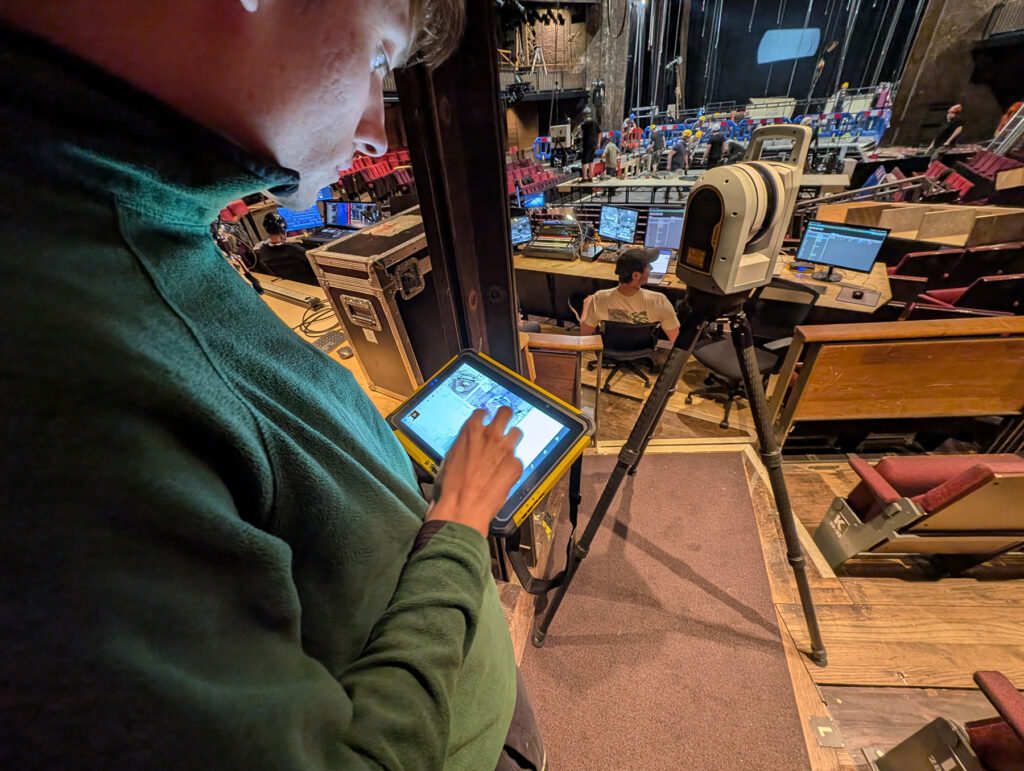
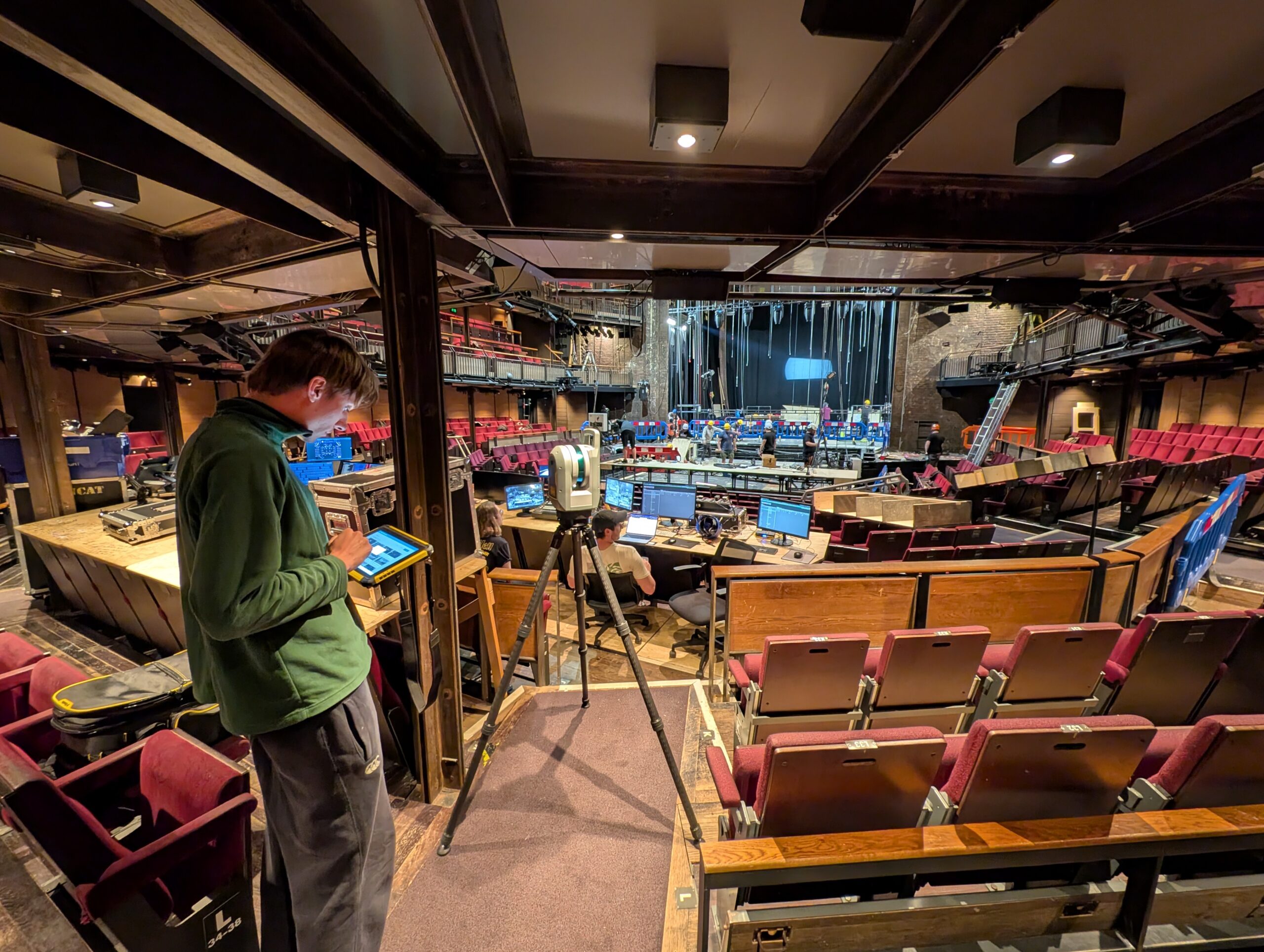
The RSC’s CAD CAM engineer, Ben, on site with the X9
At the Royal Shakespeare Company in Stratford-upon-Avon, Head of Drawing Office, Chris Pepler, holds a role that combines the creative with the technical. He specialises in solving complex engineering challenges by turning ambitious creative ideas into reality for major theatre, music, and arts events both in the UK and internationally. Chartered with the Institute of Mechanical Engineers, he also has a solid grounding in a range of skills including CAD design, CAD data management and 3D laser scanning. With this expertise, he spends much of his time collaborating with freelance creative designers to ensure their ideas work within the physical constraints of the theatre.
Moving beyond 2D limitations
Whilst many external venues to the RSC, even major national and international theatres, still work from basic 2D plans, these drawings are often insufficient to truly understand complex features such as mezzanines, split levels, fly floors, and rigging systems. In some cases, unusual architectural elements make the challenge even greater. For example, at the York Theatre Royal, the back wall, which is over 400 years old, appears on the 2D plan as a simple straight line. In reality, it is neither parallel vertically nor horizontally, significantly restricting space on an already compact stage.
Previously, any gaps in the drawings were supplemented using manual tape measurements or a DISTO and on occasion, Chris brought in an external surveyor to perform a 3D laser scan for use in their existing Autodesk software. However, the costs involved meant this service was only used sporadically and rarely for smaller jobs where it could still have been highly beneficial.
“We try and develop a show knowing that it may have a future life in other theatres, so the set is modular for an easier transferral. For us to be able to go to a venue and spend an hour scanning the stage is super useful and brings massive time benefits both from the survey point of view and the potential reworking if something doesn’t quite fit.”
The RSC already owned a basic handheld scanner which they used for simple tasks such as scanning a head to create realistic props (for example, when a severed head appears in a play) and an additional entry level scanner that although easy to use, only delivered an accuracy of +/-20mm that was not sufficient for Chris’s intended applications. The new scanner therefore needed to deliver millimetre-level accuracy, offer a straightforward workflow that supported RCP files for seamless import into Autodesk ReCap, have a short learning curve, excellent supplier support and importantly, fit within the RSC’s budget which would include the trade-in of their existing scanner.
Following extensive research, Chris opted for the Trimble X9 Core LT 3D Laser Scanner with Trimble Perspective field software. The X9 Core LT, with its 40m range, is an excellent choice for those wishing to add professional scanning capabilities to their business.
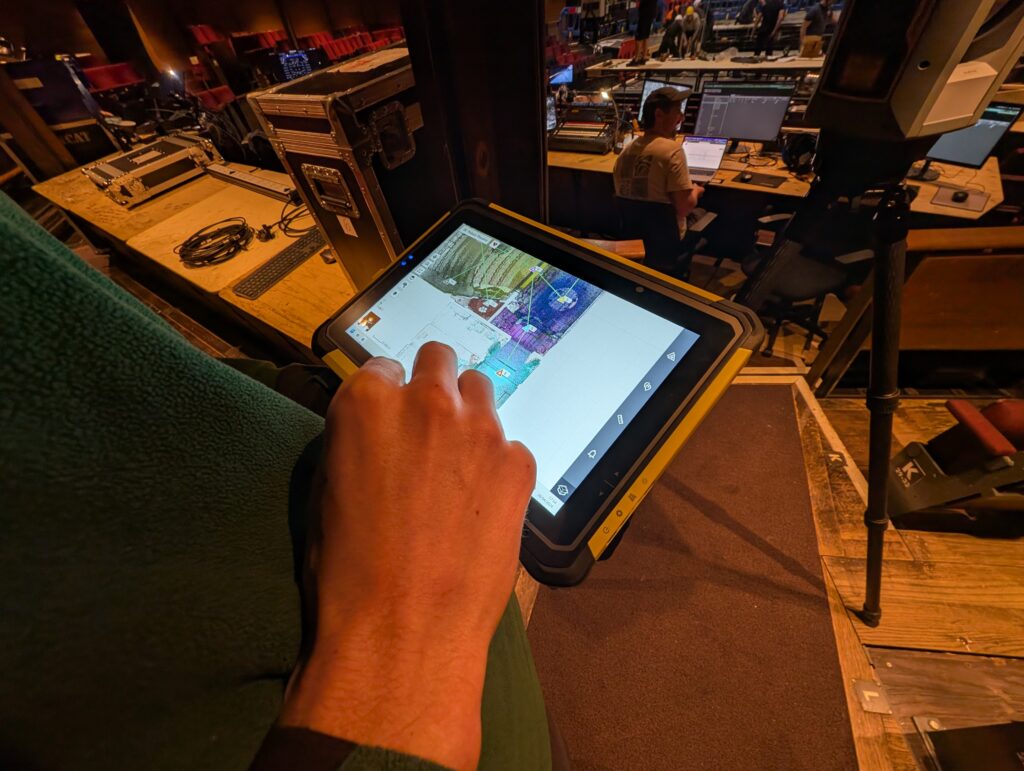
Trimble X9 Core LT 3D Laser Scanner with Trimble Perspective field software
Key benefits of the X9 for the RSC
On-site registration for live feedback during scanning and avoidance of discovering plans back at the office.
KOREC’s strong consultancy and support
Scan and image quality
Fast and easy to use
Connected workflow for use of point cloud data in existing Autodesk software
Value proposition that would deliver on price (including a trade-in), functionality and ROI
Unlimited potential: one scanner, multiple applications
Chris initially anticipated that the X9’s primary uses would be overlaying high-quality point clouds onto the RSC’s existing 3D CAD model to verify stage setups or the creation of new, accurate 3D models of venues that still used basic 2D plans. However, the X9 has proved useful in a number of different scenarios. In particular, the ability to combine detailed scans with high-resolution 360° panoramas directly in Autodesk ReCap has opened up many more valuable applications.
Improving rehearsal room set ups: The existing plans for the RSC’s rehearsal rooms in London were of poor quality. The X9 data enabled the team to better create rehearsal structures so actors could work in a realistic environment approximate to the set. Scans could also be viewed in ReCap to show freelance production managers the restrictions of the rehearsal space.
Avoiding errors on the technical grid: Chris reports that in their small theatre they were able to check feedback on an element of the rigging that didn’t quite line up as expected, indicating an error in the existing CAD model. The grid was quickly scanned to update this and avoid future problems.
Integrating new bits of the theatre into the model: For the upcoming RSC production of The Tempest starring Kenneth Branagh, Ariel will fly in the 3D space above the stage. For the first time, rigging points beyond the standard technical grid have been accurately surveyed with the Trimble X9 and the data added to the RSC’s existing CAD model.
Solving access problems in advance: The team now has precise 3D data for stairwells and entrances, making it far easier to plan how large sets can be manoeuvred into rehearsal rooms and onto the stage.
Saving time for freelance teams: By providing freelance lighting teams with photo-realistic 3D data and the CAD model, the RSC team can now pre-programme entire lighting rigs virtually – well before technical rehearsals begin. What used to take several days can now be significantly reduced using the virtual environment.
Improving the audience experience: The X9 scan data also enables detailed sightline studies for new production concepts, ensuring scenery, set pieces and staging are optimally positioned for the best possible view from every seat in the auditorium.
Ensuring smooth delivery of ambitious stage sets: Later in the year, the RSC’s Game of Thrones production will have its world premiere in Stratford. The stage layout will be significantly different to the usual front-facing arrangement and will instead feature four different stages merging at a central point. Scan data will assist in the stage design, the seating layout and the design of the set and will be a critical part of the smooth running of this massive and technically demanding show which has a very short installation time. The data is also being used for a remote freelancer to design some detailed modifications to the sub-stage and structural steelwork under the stage.
Chris concludes;
“We’re increasingly involved in co-productions both nationally and internationally. Being able to scan other venues as well as our own, instead of relying on outdated 2D plans, will be hugely beneficial. While we anticipate a good ROI on the X9, our greatest saving is one that can’t be quantified – the reduced risk of problems during installation, which could translate into significant cost savings. We simply can’t afford to have any kind of delays or modifications when we are installing and the X9 will play a large part in delivering this.”
For further information on Trimble Catalyst, please contact us here.