

KOREC Group is delighted to announce that it is expanding its operations with the launch of BuildingPoint UK and Ireland as it becomes the newest partner to join Trimble’s BuildingPoint distribution network.
KOREC Group is an existing, established Trimble distribution geospatial partner with over 50 years of experience working with the construction industry. The addition of the BuildingPoint distributorship to its already extensive geospatial portfolio underlines KOREC’s commitment to expansion which saw the company announce 30 new positions across the company at the beginning of the year.
Over 70% of UK and Ireland construction projects run over time and over budget due to a number of factors including rework, barriers to stakeholder collaboration and challenges to onsite efficiency and productivity. Through this new Trimble partnership, those that work within the construction industry, including users of Trimble Tekla, Viewpoint and MEP software, can now access a full Trimble digital construction portfolio backed up by regional expertise .
This will be delivered through a BuildingPoint team dedicated to bringing tried and tested workflows to the UK and Irish markets. These workflows have been developed to deliver increased productivity, schedule adherence and cost discipline through tighter coordination, improved project transparency and collaboration.

The offering will include assistance with the adoption of digital workflows through a range of task specific software and hardware solutions from general setting out tools to Augmented and Mixed Reality technology and Robotics.
Alan Browne, Group Chief Executive of KOREC and EY Entrepreneur of the Year Finalist 2022 said:
“The creation of BuildingPoint UK and Ireland is the next phase on our journey along with Trimble of helping our partners in Building Construction operate more safely, more quickly and more accurately whilst reducing costs and the impact on the environment”
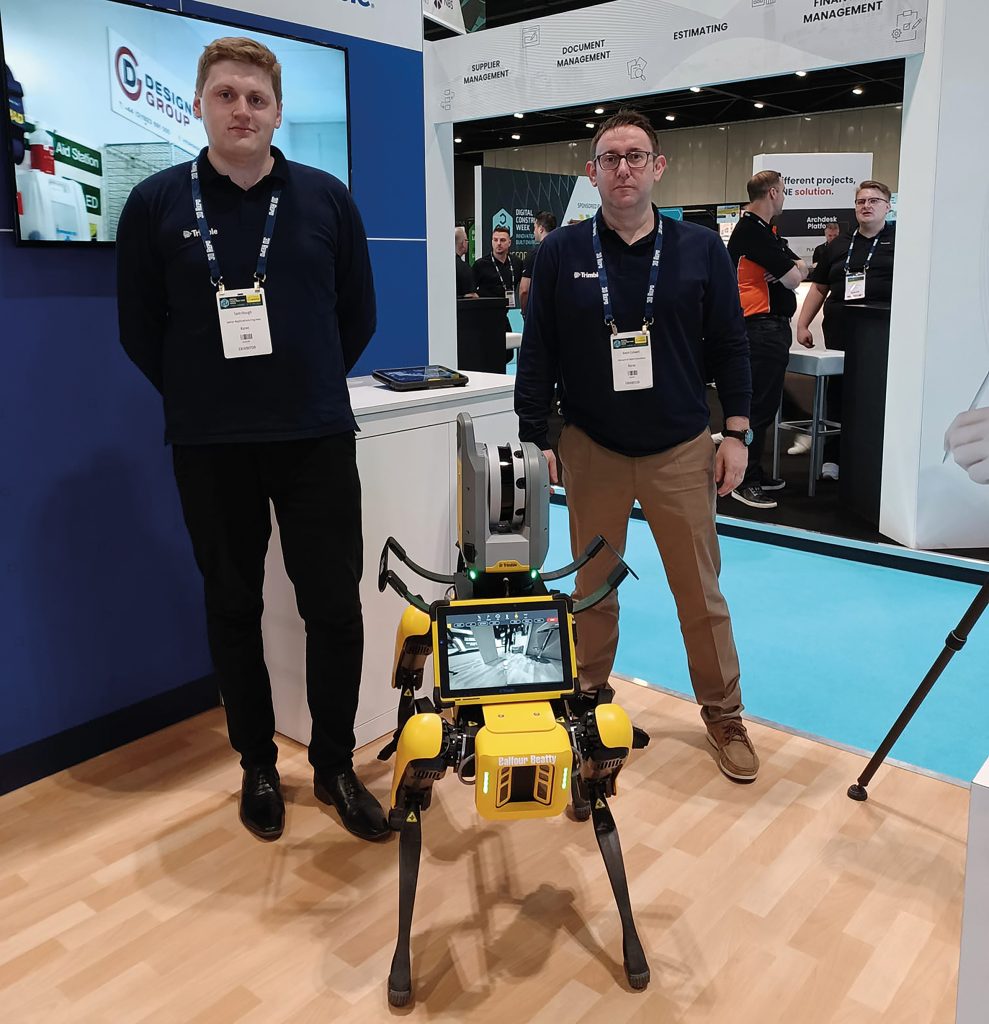
This dedicated and experienced team will be looked after by Sam Hough (UK) and Kevin Colwell (Ireland) whilst a new BuildingPoint construction focused website for the UK and Ireland has been launched at http://buildingpointukandireland.com.
The dates and locations of regional BuildingPoint launch events will be announced shortly.
ENDS
About KOREC Group
KOREC Group is an established Trimble Geospatial Distributor, one of the largest and most successful in the world and has been for over 25 years. The company has been active in the construction market since its inception in the 1960s.
Since 2019 the Trimble construction side of the KOREC offering has been operating as KOREC Construction. BuildingPoint UK & Ireland joined the global BuildingPoint family in September 2022. This network brings the full range of Trimble Buildings’ solutions to their respective markets – solutions designed to improve your productivity, schedule adherence and cost discipline through tighter coordination, improve project transparency and collaboration.
We’re now part of a growing family of BuildingPoint organisations across the Americas, Europe and Asia/Pacific.
About Trimble BuildingPoint
BuildingPoint dealers represent Trimble Buildings’ solutions—a portfolio of synergistic hardware, software and service offerings that allow users to create and transfer constructible models throughout the DBO (Design, Build, Operate) lifecycle. Trimble is dedicated to transforming the planning, design, construction and operation of buildings through advanced, accessible, intuitive technologies. Trimble Buildings’ solutions provide an unprecedented capability to improve productivity, schedule adherence and cost discipline through tighter coordination, improved project transparency and collaboration—enabling stakeholders to realise greater agility, efficiency and insight.
“Robots conducting automated on-site data capture and monitoring are coming to a construction site near you.”
Trimble Press Release
…but did you know that Spot, the agile robot with the Trimble X7 3D Laser Scanner, is already being used commercially on four different sites across the UK and Ireland!
In each case, the purchase of Spot and the X7 was based on a carefully researched benefit-cost analysis, taking into account that Spot and the X7 is an autonomous system and the only one available where contractors can operate both the robot and laser scanner through a single integrated tablet controller.
Following on from our first Spot post, ‘What does autonomy mean to you’, we look forward to bringing you stories from all of Spot’s ‘owners’ and first up in this series is a look at how Balfour Beatty’s Digital Plant Manager, Mark Crawford, assisted the company to become the first in the UK to have the fully integrated Trimble workflow between Spot and the X7.
Mark explains how autonomous Spot was introduced to a working site at the end of 2021:
“This integrated workflow means that not only do we have a ‘working’ dog instead of a ‘show’ dog but it’s also our first robotic employee, who has already been out walking and capturing data across our site in Derby for the last 48 hours.
We spent day one doing business introductions and site inductions with a full site tour for operational familiarisation, plus the expected fun of walking up and down stairs, over obstacles, through the offices and then we got down to some proper work.
Out on its own in the wet and windy weather we’ve completed its first solo fieldwalk mission, with a 12 scan set up, all done in 18 minutes of scanning time and 10 minutes of travel – back on the dock and point to point registration and refinement complete in under 10 minutes has resulted in us capturing 65.4 million points and a working model to measure off for our facilities team.
There’s been a lot of buzz and excitement around this platform and integrated solutions and quite rightly so. To be able to get one in, employed and deployed on our sites only heightens that excitement when you start to consider the art of the possible on the journey of robotics and reality capture and automated tasks.”
Spot podcast – autonomous applications

Following on from the introduction of Spot, Mark teamed up with Trimble’s David Burczyk, Construction Robotics Lead at Trimble Connected Construction, to record a Spot podcast for the Constructive Voices series. This is an extremely informative look at how the business decision to purchase Spot and the X7 was reached and what Balfour Beatty hopes to achieve through this innovative step. Both have plenty of insights to share:
“We’re doing things with a remote operator app which will allow you to remotely operate Spot without having to be physically on the same job site.” David Burczyk, Trimble.
“Sellafield has worked with Spot to take radiation readings…. with a person operating him from a place of safety and the robot goes instead. That’s got to be a win in anybody’s eyes.” Mark Crawford, Balfour Beatty.
Listen to the podcast here:
What’s Next?
- Check out the Trimble X7 product page
- Check out Spot in action over on our YouTube channel;
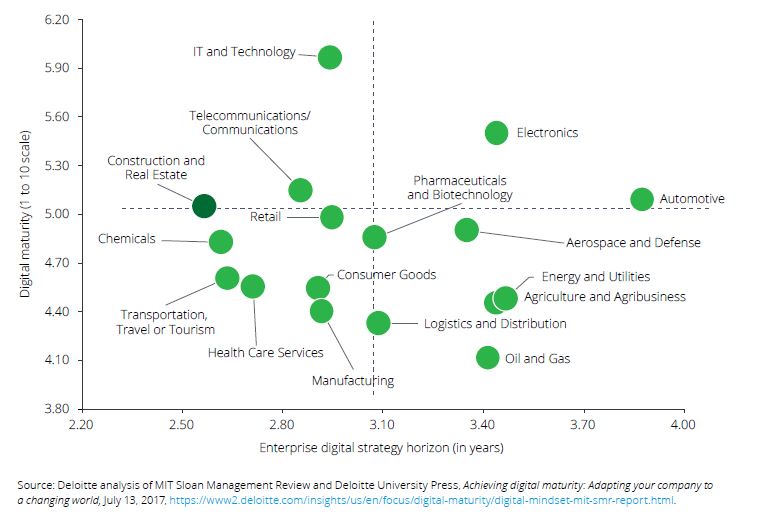
A recent report by Deloitte on the development of the construction and engineering industry until 2050 identified the key trends set to shape the industry, the priorities and challenges that construction professionals should be aware of, and the technologies and solutions that are on hand to help us meet these challenges.
The report defines Connected Construction as an ecosystem – a connected network of capabilities such as collaboration, real-time project visibility, worker safety and data that promotes the most effective, efficient, productive and safe delivery of projects.
As a key equipment supplier to the sector, in both Ireland and the UK, KOREC believe that it is vital for our customers to be aware of these findings, and to present solutions for how we can tackle the challenges, head-on.
We’ve reviewed the report and pulled out what we believe to be the key findings, which we’ll present over 3 sections – the challenges, the key technologies involved, and finally, the opportunities.
The Opportunities
We’ve identified four broad areas of opportunity that focus around; processes, data, people and future-proofing. We believe there are huge gains to be made by forward-thinking firms that take the time now to investigate the technologies that are available to them.
Streamline your Processes
A digital record of project plans (literal 2D & 3D plans, as well as scheduling) brings a wealth of information to your fingertips. Construction software such as Trimble FieldLink create a fully-connected flow of information both from and to the office allows you to avoid guesswork, make informed decisions on site, and cut down on the risk of costly errors. Other tools such as Bluetooth beacons, managed WiFi and on-ground sensors can track equipment performance and maintenance – equipping you with the latest information you need in order to make informed decisions.
Leverage your data’s full potential
Office-designed BIM models contain a huge amount of valuable information and data about a project – why lose a huge chunk of that value when bringing the design onto site? With connected, digital and paperless solutions, you are ensuring that the data you are working to on site, is identical to the data prepared in the office. What’s more, with tools such as the XR10 it’s simple to mark-up changes on site – which can then immediately be updated on the BIM. A virtuous cycle of powerful information, between the office and the build site.
Upskill your Staff
Autonomous or semi-autonomous technologies, such as robotic total stations, drones, and even robots, can take the slack when it comes to hazardous, repetitive or unskilled tasks. For example, a robotic total station requires only one semi-skilled operator, not two – immediately reducing personnel on site – or freeing them up for other tasks. Looking further afield, robots (or co-bots as they’ve been termed) such as Spot the Dog can be programmed by their human colleague to undertake manual tasks – even working throughout the night and at weekends to drastically cut programme schedules.
Future-proof your Business
The construction and engineering sector is at somewhat of a crossroads – huge global demand, a wealth of interconnected technologies available, stubbornly-low profit margins, growing concerns around environmental sustainability, and a well-publicised skills shortage.
In order to attract a new generation of educated, informed and skilled workers to the profession, the sector must engage with currently-available connected technologies, which will in turn drive down costs, and drive demand for new solutions.
At a business level, those organisations (such as Nugent Manufacturing) that take a long-term, joined-up and open-minded approach are more likely to experience the gains in productivity, efficiency, safety and profit margins that those who operate in a business-as-usual manner. And it is those digital-ready organisations that are best placed to attract the top talent to ensure their future growth.
Key Technologies
The report identified 6 key technologies, some of which are already beginning to make major inroads into the efficiency and productivity of our industry;
1.Robotics
Dull, laborious and repetitive tasks are better performed by a robotic assistant (see Spot the dog from Trimble & Boston Dynamics!), freeing up their human colleagues for safer, higher-skilled tasks
2. Automation
The growth of AI could lead to the rise of intelligent buildings – structures that learn how to run and operate themselves – saving energy, money and resources
3. 3D-printing
Having accurate, digital design information (as provided by the Trimble X7 3D scanner) allows for complete 3D-printed assets (including the world’s first inhabited 3D printed house)
4. Autonomous Vehicles
High-accuracy data of construction sites paves the way for robotic ‘workers’ to work around the clock – leading to huge reductions in project delivery timescales
5. Unmanned Aerial Vehicles
Rapidly becoming a fixture of construction sites across the country, UAVs enable the rapid and contact-free survey of large and difficult to access areas – ideal for regular project progression updates and site inspection.
6. Virtual, Augmented and Mixed Reality
Visualise completed projects before ground has even been broken – augmented reality solutions such as SiteVision allow for unbuilt, underground or unseen features to be viewed in-situ, whilst wearable mixed-reality such as the XR10 allow contractors (as well as clients) to undertake walkthroughs of complex sites.

There is a link to download the full 16-page report at the bottom of the page.
The Challenges facing our industry
- Only ¼ of the global infrastructure we’ll need by 2050 exists today. Every single day, over 200,000 people move into the world’s urban centres.
- The Construction industry is only looking 2.5 years ahead when it comes to digital strategy – ranking bottom out of 17 industries for forward-thinking and planning.
- Profitability and margins are stubbornly low – earnings averaging just 5% of sales. Not only does this affect the bottom line, it also deters higher-skilled graduates from entering the profession
- Engineering and construction firms experience an average of 82-days outstanding sales (i.e. unpaid invoices) – longer than all other industries. Again, this affects cash-flow and stunts the ability of the business to invest.
Find Out More…
Case Study – how one KOREC customer are punching well above their weight by investing in a complete field-to-finish digital construction workflow
- Download the complete Deloitte report
- Check out our complete range of laser scanners, robotic total stations, mixed reality and office-to-site software
- Speak to us about our range of digital construction tools
KOREC Group have cemented their dedication to the construction industry, by becoming a signed-up member of COMIT.
Short for Construction Operation & Maintenance through Innovative Technology, the organisation’s mission is to foster greater ties between the construction and technology industries, in order to speed up the adoption of innovative technologies in the sector.
As a leading supplier of cutting-edge construction solutions (such as the X7 laser scanner, RTS total stations and XR10 mixed reality headset) KOREC has the solutions, the experience and the expertise to drive forward productivity, safety & collaboration in the sector.

KOREC is a leading supplier of digital construction solutions to both the UK & Irish construction markets
KOREC join major industry players such as Balfour Beatty, BAM Nuttall, Costain & Morgan Sindall in the group, and hope to play a strong role in communicating the effectiveness of digital construction workflows to industry partners – both small and large.
KOREC make their COMIT debut this Friday at the ‘Happy Hour’ event, joining a panel discussion on the theme of ‘How to leverage data from the field to drive greater Quality, Safety & Productivity on your sites’.
KOREC’s UK Sales Director Mark Reid will represent the company at the session, and join the panel discussion following a presentation by fellow member Novade.
This will be followed by KOREC’s own presentation to the COMIT members at a session in May.
Find out More
- To find out more about the work of COMIT, take a look at their website
- Take a look at KOREC’s digital construction solutions
- Follow KOREC Construction on LinkedIn
Setting out is a laborious, time-consuming yet vital stage of the construction process.
With our February trade-up offer, you can ensure you have the most robust, most productive and most cost-effect setting out workflow available.
To make things better, we’ll give you £4000 / €4500 to upgrade your old survey kit for a brand-new, setting out solution built for the digital construction site.
For more details of this limited time setting out offer, download our handy 1-page PDF.
Prefer to speak to an expert? Get in touch via our Contact page.
Find Out More
- Read how the RTS773 helped Felix O’Hare deliver a complex project 6 weeks ahead of schedule – Customer Story
- Read our handy blog ‘Visual Setting Out – 5 reasons why’
- Browse the full range of robotic total station solutions
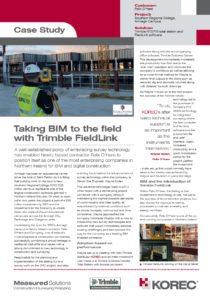
A well-established policy of embracing survey technology has enabled Newry based contractor Felix O’Hare to position itself as one of the most enterprising companies in Northern Ireland for BIM and digital construction. So it comes as no surprise that under the guidance of Senior Site Engineer, Wayne Nolan, a driving force behind the advancement of survey technology within the company, that Felix O’Hare was one of the first companies in Ireland to adopt a KOREC supplied Trimble RTS and FieldLink system.
Wayne had a clear idea of what he required from a BIM compatible digital setting-out system and this useful case study explains exactly what he wanted and how he met those demands. Read the full story here.
For full details on our special upgrade offer, click here.
How would you like to complete five times the amount of work, with just 1 operative?
More construction contractors are realising the value of visual setting out with robotic total stations. They’re seeing firsthand the gains in speed, efficiency, and accuracy. These benefits translate to reductions in rework, schedule delays, and other costly problems, all of which contribute to a robotic total station’s ability to pay for itself many times over.
What is Visual Setting Out?
But not all robotic total stations are made the same. While prism pole layout is the norm, some robotic total stations also offer a laser pointer. Using a laser is referred to as visual setting out, and it works especially well in structures and buildings that are already erected. When you use a robotic total station that allows you to do both prism pole layout and visual layout, you get the ultimate in flexibility and versatility. Here are five reasons to take a closer look at visual setting out.
Reason 1 – SPEED
When conditions permit the use of a laser, you’re able to speed up the setting out process considerably. You can turn on the laser and stand back as it automatically points and measures, reducing the time needed to position and locate the prism pole. Integrated software in the robotic total station, like Trimble FieldLink, guides you to each point and allows you to switch between surfaces, such as from the floor to the ceiling. You can eliminate extra steps, which cuts the time needed to complete set out significantly, while also gaining greater precision.
Reason 2 – ACCURACY
To get an accurate measurement with a prism pole, the pole needs to be perfectly plumb. Even a slight misplacement could produce a measurement that’s a few cm off. This type of human error is difficult to avoid when you’re relying on manual processes. But when you rely on Trimble’s patented visual set out technology to let the robotic total station do the adjustments and calculations for you, you can achieve much greater accuracy.
The precision of visual set out is especially beneficial for MEP contractors. Pipes and floor drains, for example, have to be accurately placed to drain correctly and pass inspection. Electrical work, HVAC, and sprinkler systems have to be placed accurately at the right elevations to clear other systems and avoid clashes. With the accuracy the laser provides, you can have greater confidence that your work will be set out and installed correctly.

Reason 3 – EFFICIENCY + REDUCTION OF PERSONNEL
Manual setting out is a time-consuming process that can take weeks or longer depending on the size of the project. It also requires that you have enough pros available to complete the work—a challenge given the construction skills shortage. With a robotic total station, though, only a single operative is needed to operate the instrument, whether using the prism pole or the laser. And because of the automated capabilities of the laser, fewer steps are needed to set out points, which significantly reduces the amount of time needed.
In fact, in many cases, you can complete 5 times the amount of work with one person. You’re able to deploy the setting out resources you have more efficiently and across more projects.
Reason 4 – SAFETY
Busy jobsites tend to be full of potential hazards, and performing set out in the midst of these hazards can be risky. With the visual setting component of a robotic total station, you can shoot the laser over 100 meters, which means you don’t have to physically make your way across the jobsite to measure a location. You’re able to avoid trip hazards or other potentially dangerous areas. You can also reduce the use of ladders, which pose one of the greatest safety risks to construction workers.
Reason 5 – COST & ACCOUNTABILITY
Because you can perform setting out more quickly with the laser, you’re more likely to meet the project schedule. And any time you can stay on schedule, you’re improving your likelihood of staying on budget. In addition to performing set out, a robotic total station also allows you to create a record of work performed. Should you receive an RFI or have to resolve a dispute over charges, you can reference this documentation to show what you did and why. This same feature lets you quality check your work as you go so you can identify and resolve problems before they turn into profit-robbing rework.
See our full range of Robotic Total Stations for Construction, and other BIM tools.